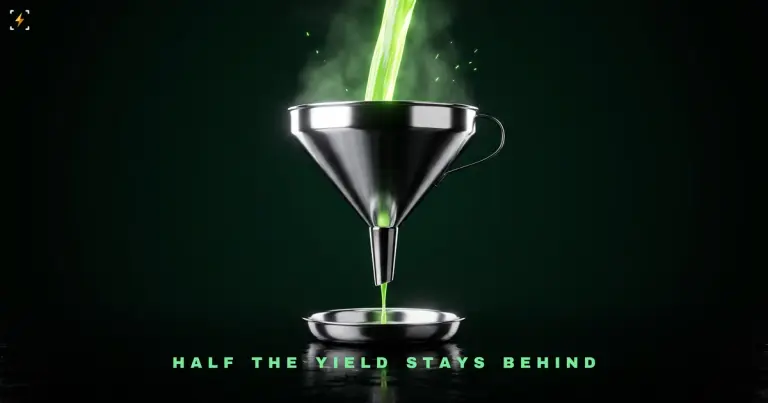
A 3.24% yield reaches the shareholder as 1.49%
Canary Capital listed the first US staked TRX ETF on Cboe on Wednesday under the ticker TRXS, CoinDesk reported. It buys TRX, stakes substantially all of it, and adds 80% of the staking rewards to net asset value instead of paying them out. The sponsor fee is 1.10% a year.
Those three numbers decide what a buyer gets, so we ran them.
Where the yield goes
Staking Rewards puts TRX staking at 3.24% a year. Pass 80% of that into the fund and the shareholder sees 2.59%. Take the 1.10% sponsor fee off and 1.49% is left.
The fund and its sponsor keep 1.75 percentage points, which is 54% of the on-chain yield. A holder staking TRX in a wallet keeps all of it.
That is the trade the product offers: half the yield in return for never touching a validator, a wallet or a claim button. Whether half is a fair price depends on what the buyer thinks the convenience is worth.
The price does the rest of the work
TRX trades at $0.3392 and has gained 0.64% over the past twelve months. Run last year again with this fund on top and the total comes to about 2.1%.
That flatness is the case for a staking wrapper, not an argument against it. When an asset goes nowhere, the yield is the return, and TRX has gone nowhere for a year while sitting eighth by market value at $32.2 billion.
We wrote last week about the gap this opens: Tron carries $95 billion of stablecoins while TRX itself lags behind that activity.
“As stablecoin adoption continues to grow globally, TRON has become a critical piece of the infrastructure powering digital asset payments and settlement.”
— Steven McClurg, Canary Capital, 9 September 2026
Steven McClurg, chief executive of Canary Capital. Source: Canary Capital statement, 9 September 2026
The fourteen days nobody mentions
Tron's Stake 2.0 makes you wait 14 days to unstake. A fund that stakes substantially all of its holdings has to meet redemptions from somewhere else, and how Canary handles that is a question for its filings.
TRX also trades thinly for its size. It turned over $320 million in the last 24 hours against a $32.2 billion market value, a ratio of 1.0%. Bitcoin turns over 2.1% of its market value in a day. A fund handling large redemptions in a 1% market has less room than the headline size suggests.
What the rest of the shelf pays
The Solana funds stake from day one and quote 6% to 7% gross. BlackRock's ethereum staking trust, listed in March, stakes 70% to 95% of its holdings and distributes 82% of rewards to shareholders every month.
Set against those, Canary's 80% pass-through is standard and its 1.10% fee is the outlier. On a 3.24% yield a 1.10% fee eats a third of the gross. On Solana's 6.5% the same fee would eat a sixth.
Canary filed the S-1 in April 2025 and reached the market seventeen months later. The product does what it says it does, and the arithmetic between the network and the shareholder is the part to read before buying. For scale, the bitcoin funds we measured yesterday hold $99.61 billion; this one starts from zero.
Nothing here should be taken as financial advice; treat it as information to consider.

Author
MaksTrading man
I've been interested in the cryptocurrency market for a long time, am a trader, and write articles and news about my experience and crypto in simple terms.
Comments (0)
No comments yet — be the first!
Join our community
No spam, unsubscribe in one click
Related news



Most readTop 7

Silicon Valley Workers Are Wearing Noise-Cancelling Masks to Dictate AI Prompts
379AI

