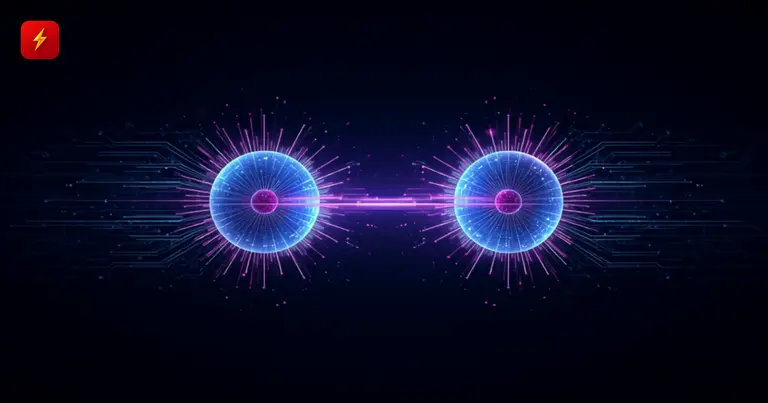
D-Wave tests entanglement on dual-rail qubits, a step toward fault tolerance
D-Wave published a study in Nature demonstrating a fast two-qubit entangling gate with roughly 99.9% fidelity on its dual-rail superconducting qubit architecture, which preserves built-in, hardware-level error detection.
The gate runs in about 500 nanoseconds. As part of the study, researchers generated a logical Bell state with 98.8% fidelity, with an entanglement storage time an order of magnitude longer than that of the uncorrected physical counterpart. Per D-Wave's simulations, the dual-rail architecture could cut the logical error rate by as much as 10x per error-correction scaling increment, significantly reducing the physical qubit overhead required. "Gate-model quantum computing's greatest remaining challenge is not simply building more qubits. It is building systems that can correct errors efficiently as they scale," said D-Wave CEO Dr. Alan Baratz.
- Two-qubit gate fidelity of roughly 99.9%, with a gate time of about 500 nanoseconds
- A logical Bell state was achieved at 98.8% fidelity
- Per the company's simulations, the logical error rate could drop 10x per correction increment
Progress in quantum computing is watched closely by the crypto industry too — not as a reason for panic, but as a long-term risk factor for the cryptography that underpins bitcoin. Just today we covered how TV host Jim Cramer sold his bitcoin specifically over quantum computing fears. Technical announcements like D-Wave's don't bring a real "quantum threat" meaningfully closer on their own — they're about error correction in gate-model systems, not breaking cryptography directly — but they're exactly the kind of milestone the industry uses to gauge how fast progress is actually moving.
None of this should be read as personalized investment advice.

Comments (0)
No comments yet — be the first!
The market talks all day. We write when it says something
Short, and it tells you why it came
Related news


Most readTop 7

Silicon Valley Workers Are Wearing Noise-Cancelling Masks to Dictate AI Prompts
332AI

