
A nine-asset crypto index where two of them are 86% of it
The Nasdaq CME Crypto Index holds nine cryptocurrencies, and bitcoin is 74.47% of it. Someone buying the index to own the asset class is buying bitcoin with a garnish, and the garnish is smaller than most people picture.
“A desk building a hedge around today's 74.47% bitcoin weighting should expect that number to move by the next quarterly reset.”
— Cryptonews, on the index weights
Cryptonews, on hedging against a moving weight
Here is the whole basket, by weight:
- Bitcoin and ether together: 86%.
- The other seven constituents share 14% between them.
- The four smallest, Cardano, Chainlink, Stellar and Bitcoin Cash, come to 1.4% combined.
- Hyperliquid alone, at 3%, outweighs those four by 2.1 times.
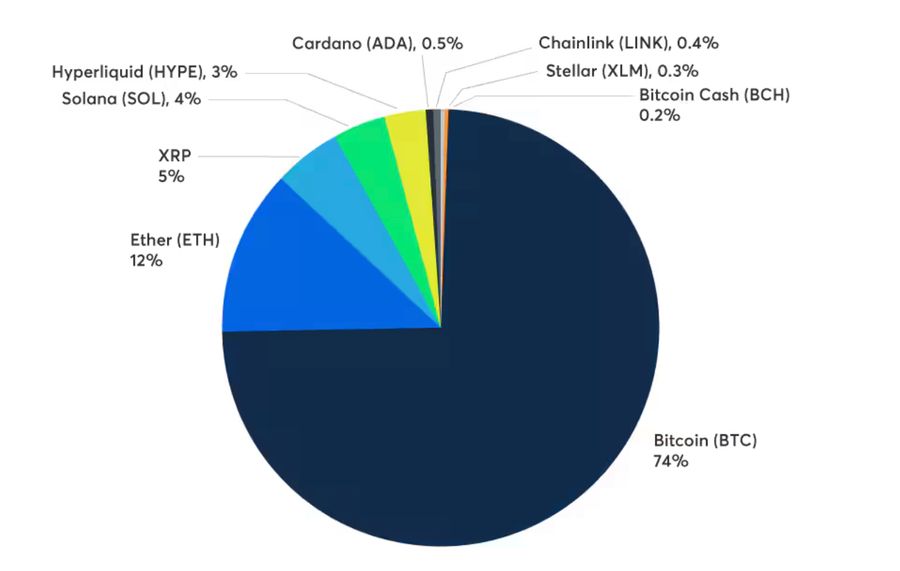
Read the tail rather than the head and the arithmetic gets blunt. Stellar sits at 0.3%, so it would have to rise 333% to add a single percentage point to the index. Double every one of the four smallest constituents at once and the index gains 1.4%. Those assets are in the basket for completeness, not for contribution, and a buyer holding them through this product will never feel them.
The tail rounds to nothing
None of this is a design flaw. The index weights by market capitalisation and liquidity, and it rebalances quarterly, so the shape reflects the market rather than a committee's taste. What deserves attention is the gap between the shape and the language around it. An index marketed as exposure to crypto as an asset class delivers a portfolio in which one asset outweighs the other eight by nearly three to one.
The concentration is not unique to the index either. We counted yesterday that the top ten altcoins now hold about 80% of the whole altcoin market cap, up from 70% at the end of 2024, while dealer participation halved. A cap-weighted index sitting on a market that concentrates will concentrate with it, and this one is downstream of that, not the cause of it.
What the chart is useful for
The same pattern showed up in the flows last week. Solana ETFs took a record $188m and one issuer took two thirds. Whether you look at index weights, at fund flows or at 48 hours of price action, the answer keeps coming back as a small number of names carrying everything and a long tail that rounds to nothing.
The practical use of the chart is as a translation table. If your reason for holding the index is bitcoin, it does the job well and charges you for eight assets you did not need. If your reason is diversification, the chart is the argument against your own position, and it is published by the index provider rather than by a critic.
Informational only, not investment advice. Index weights are a snapshot and change at the quarterly reconstitution, which can add or drop constituents entirely.

Comments (0)
No comments yet — be the first!
The market talks all day. We write when it says something
Short, and it tells you why it came
Related news


Most readTop 7

Silicon Valley Workers Are Wearing Noise-Cancelling Masks to Dictate AI Prompts
324AI

