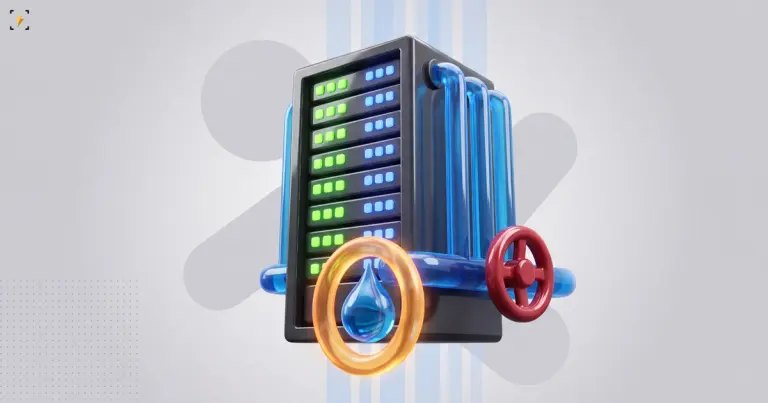
Nvidia Mission Control can shut down AI racks when coolant leaks
A coolant leak in an AI data centre is a plumbing problem and a computing problem at the same time. Nvidia Mission Control now handles both: the software can stop the jobs on a leaking server, cut its power and tell the building to close the valves without waiting for an engineer.
Nvidia described the setup in a technical blog post on 19 November, written by product architect Ryan Prout and Casey Dugas, who leads product marketing for Nvidia's infrastructure software. It applies to clusters built on GB200 NVL72 and GB300 NVL72, Nvidia's liquid-cooled rack systems.
Liquid brings a new failure
Liquid carries away more heat per rack than air, which lets operators pack more computing power into the same floor space. It also brings water next to the electronics, a failure that air-cooled halls never had.
Two teams usually share that risk. IT staff run the servers and the jobs on them. Facilities staff run power, pipes and valves through a building management system. In a leak both teams have to act within minutes, and the Nvidia authors name that coordination as the hard part.
“The challenge is coordinating these actions across systems quickly and reliably.”
— Ryan Prout and Casey Dugas, Nvidia, Nvidia technical blog, 19 November 2026
Quote source: Nvidia blog
Nvidia Mission Control during a leak
- Links to the building: the cluster software talks to the building management system over MQTT, a lightweight messaging protocol from industrial automation
- Scales the response: policies follow the layout of the site, from a single device to a rack, row, room or the whole building
- Acts on its own: a policy can power down one tray when one device reports a leak, or cut power and cooling to a row and close facility valves when three or more racks in it report leaks
- Keeps a record: a command called leakinfo lists past leak events with time and severity, and the data feeds Prometheus and Grafana dashboards
Nvidia ships five preset policies, one each for a device, rack, row, room and building, and operators can edit them or write their own.
The trade-off for operators
Every hour a rack spends offline costs training or inference time, so operators want a leak contained in one tray before it spreads to a row. A policy written in advance replaces a phone call between two teams in the middle of the night.
Building failures can take the computing down with them. Readers may recall our story on Lake Mariner, the data centre that burned in June and still had dry hydrants in August.
The automation has a cost too. A rule tuned too broadly could power off a whole row over one faulty sensor, and Nvidia's own sample log shows two critical cold-plate leak alerts on DGX nodes. Operators will want to test the presets on their own hardware before they let the software close valves by itself.
This news describes Nvidia's product as the company presents it and is not a recommendation to buy Nvidia hardware or shares.

Author
MaksTrading man
I've been interested in the cryptocurrency market for a long time, am a trader, and write articles and news about my experience and crypto in simple terms.
Comments (0)
No comments yet — be the first!
Join our community
No spam, unsubscribe in one click
Related news



Most readTop 7

Silicon Valley Workers Are Wearing Noise-Cancelling Masks to Dictate AI Prompts
406AI

