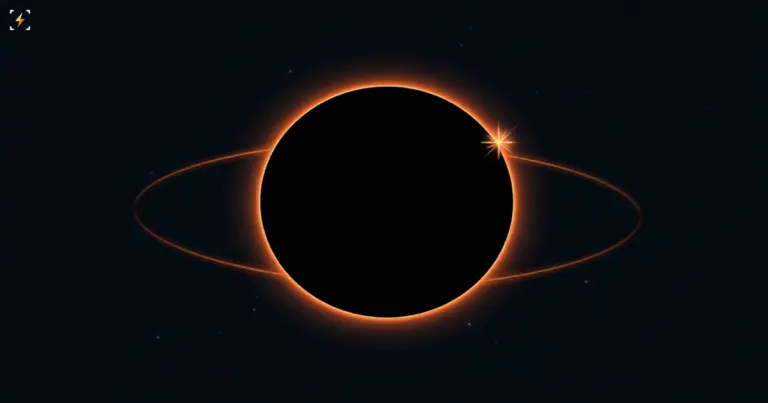
New star S301 orbits closer to the Milky Way's black hole than any known
Astronomers found a star that passes closer to the Milky Way's central black hole than any star identified before it, Ars Technica reported, citing a study published Wednesday in Nature. The star, named S301, comes within about 11 astronomical units of Sagittarius A* at its closest approach, roughly the distance between the sun and Saturn, and moves at close to 25,000 kilometers per second there, more than 8% of the speed of light.
A team using the GRAVITY instrument on the European Southern Observatory's Very Large Telescope has tracked stars near Sagittarius A* since 2017. GRAVITY combines light from four separate telescopes to match the resolving power of a single 130-meter telescope. The team first spotted S301 moving away from the black hole in 2023, then spent several months building an orbital model precise enough to trace the star's position backward and confirm the sighting. That model puts S301's closest approach in early 2023, at a distance about 10 times nearer to the black hole than the previous record holder.
S301 completes a full orbit in 8.7 years, more than three years faster than any other known star near Sagittarius A*. Its orbit has an eccentricity of 0.9832 on a scale where zero describes a perfect circle and anything above one describes an object escaping its host entirely. Pluto's eccentricity, by comparison, sits at 0.25. The star itself is about 1.5 times the size of the sun. A larger star on the same path would likely get torn apart by the black hole's gravity at closest approach. The researchers think S301 arrived as part of a binary system that wandered too close to Sagittarius A*, with its companion star ejected from the neighborhood entirely.
- Closest approach distance to Sagittarius A*: about 11 astronomical units, roughly Saturn's distance from the sun
- Speed at closest approach: about 25,000 kilometers per second, over 8% of light speed
- Orbital period: 8.7 years, the shortest known for a star this close to the black hole
- Orbital eccentricity: 0.9832, compared with 0.25 for Pluto
- Estimated mass of Sagittarius A*: nearly 10^37 kilograms
Mass and spin are the only two properties a black hole can have under general relativity, alongside charge, which has no way of being measured. Scientists have inferred that Sagittarius A* spins, based on gravitational-wave detections from other black hole mergers, but nobody has measured its spin directly. That effect on a star's orbit fades with the cube of the distance from the black hole, so a star has to either pass extremely close or be watched for an extremely long time before the effect becomes visible. Most known stars near Sagittarius A* would need thousands of years of observation to reveal it. The research team estimates that current instruments can already track S301 with enough precision to produce a spin measurement within about a decade, turning the star into a working tool for probing a black hole no telescope can image in detail.
The discovery adds to a run of instrument-driven breakthroughs in space science this year. NASA's Roman Space Telescope, built primarily to study dark energy, turned out capable of spotting hazardous asteroids as a side effect of its wide field of view, a reminder that instruments built for one scientific goal keep finding uses nobody planned for. GRAVITY was built to sharpen images of the galactic center, not to hunt for record-setting orbits, and it may end up doing more for black hole physics through the second use than the first.
None of this should be read as personalized investment advice.

Comments (0)
No comments yet — be the first!
The market talks all day. We write when it says something
Short, and it tells you why it came
Related news

Australia's crypto deadline closed on 45 applications from about 400 platforms

The case against guardrails, and the three counts we already have
Tesla delivered 22,141 more cars than it built, and the stock rose 5%
Most readTop 7

Silicon Valley Workers Are Wearing Noise-Cancelling Masks to Dictate AI Prompts
338AI

