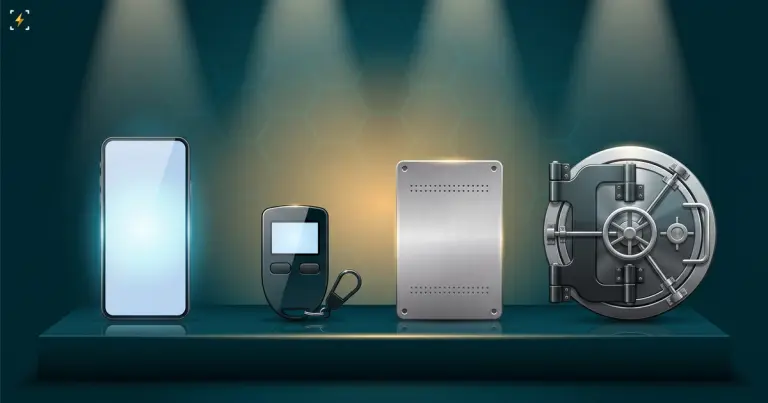
Types of crypto wallets: hot, cold, custodial and hardware explained
A crypto wallet keeps the private key that moves your coins, while the coins themselves stay on the blockchain. Whoever controls that key controls the funds, so the types of crypto wallets differ in where the key lives and who can reach it.
Two questions sort almost every wallet on the market. Is the key connected to the internet? And do you hold the key yourself, or does a company hold it for you?
Hot and cold wallets
A hot wallet keeps its key on a device that goes online: a phone app, a desktop program or a browser extension. You can pay, trade and connect to DeFi apps in seconds. The same connection gives malware, phishing pages and fake extensions a route to your key.
A cold wallet keeps the key offline. In practice that means a hardware wallet in most cases, a small device that signs transactions inside its own chip and shows the details on its own screen. The key never reaches your computer, so a compromised laptop cannot copy it. You pay for that with speed: every transfer needs the device in your hand.
Exchanges use the same split. They keep a small hot balance for withdrawals and most client funds in cold storage, because a hot wallet is the first thing attackers go after.
Custodial and non-custodial wallets
A custodial wallet is an account where a company holds the keys: an exchange, a broker or a payment app. You log in with a password and two-factor code, and you can reset access if you lose it. You also depend on that company staying solvent, honest and unhacked, and it can freeze your balance.
A non-custodial wallet gives you the keys as a seed phrase, a list of 12 or 24 words. Nobody can freeze it or lose it for you, and nobody can restore it either. Lose the phrase, and the coins are gone for good.
Software and hardware wallets
Software wallets come in three forms:
- mobile apps, the most common way people hold crypto day to day
- browser extensions, which connect to DeFi apps and NFT marketplaces
- desktop programs, often used for a single network such as Bitcoin
Hardware wallets are dedicated devices from makers such as Ledger, Trezor, Keystone or Tangem. Some connect by cable or Bluetooth, others pass data through QR codes and never connect at all. A paper wallet, a printed key, belongs to an older era: printers, scanners and cameras can all leak it.
Multisig, MPC and smart contract wallets
A multisig wallet needs several keys to approve a transfer, for example two of three. Companies, funds and families use it so that one stolen key is not enough.
An MPC wallet splits one key into shares held on different devices or servers, and the shares sign together without ever being joined. Smart contract wallets go further and put the rules on chain: spending limits, recovery through trusted contacts, fees paid in stablecoins.
Most people end up with more than one type. You might keep a phone wallet with a small balance for payments and a hardware wallet for savings, and treat an exchange account as a place to trade, not to store. If you give each wallet one job, you decide where you accept the risk of a hot connection and where you pay for the slower, safer device.
This guide describes how wallet types work and is not a recommendation of any product or service.

Author
MaksTrading man
I've been interested in the cryptocurrency market for a long time, am a trader, and write articles and news about my experience and crypto in simple terms.
Comments (0)
No comments yet — be the first!
Join our community
No spam, unsubscribe in one click
Related news

Bitcoin falls below $70,000 as the fear index hits a four-month low

Trump backs Tim Cook as Jensen Huang's successor at Nvidia

Jensen Huang resigns as Nvidia CEO, Colette Kress becomes interim chief
Most readTop 7

Silicon Valley Workers Are Wearing Noise-Cancelling Masks to Dictate AI Prompts
395AI

