Visa Buying Fireblocks: What It Means for Crypto Custody
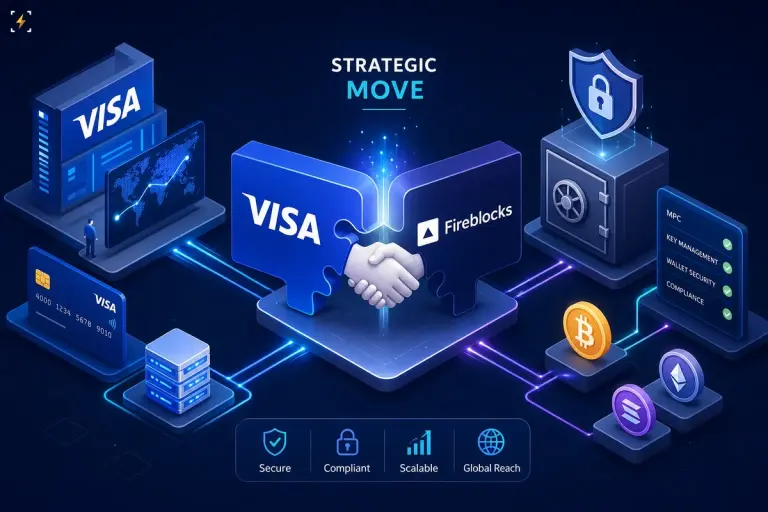
If you've been asking how will Visa acquiring Fireblocks change crypto custody, here is the short answer: if this deal closes, Visa would own the MPC custody infrastructure that BNY Mellon, Revolut, Worldpay, and more than 2,500 other enterprises currently run on. That's not an acqui-hire of a promising fintech team; it's a structural claim on who controls the settlement layer beneath institutional crypto. Axios reported late-stage acquisition talks at roughly $2.5 billion. Fireblocks responded publicly that the report was "not true at present time." Visa declined to comment. There is no signed agreement, no regulatory filing, and no confirmed purchase price as of November 3, 2026. The strategic logic behind the deal, however, holds regardless of whether the paperwork ever gets signed. This piece breaks down what changes for custody standards, insurance coverage, settlement timelines, and every stakeholder category if the acquisition goes through.
Key Takeaways
- Deal status is unconfirmed: Axios reported ~$2.5 billion in late-stage talks; Fireblocks denied it; Visa stayed silent. No transaction is legally binding as of publication.
- MPC infrastructure is the real prize: Fireblocks gives Visa a permissioned counterparty settlement network and programmable custody governance sitting directly beneath its stablecoin card programs.
- Regulatory approval is not a formality: A payment network owning a custodian creates a compliance perimeter far larger than either entity operated independently.
- Operators should act now: Review custody agreements, data portability rights, and exit terms before any change of control is announced, not after. Confirm which entity holds legal title to your assets and what your insurance limits actually cover.
What's Confirmed and What Remains a Rumor
The Axios report alleged late-stage acquisition talks and cited a figure of approximately $2.5 billion. The gap signals either a substantial markdown since the 2022 crypto peak or a negotiation that's considerably more complicated than a single headline figure suggests. No signed agreement, regulatory filing, announced closing date, or confirmed deal structure has emerged from either company.
What gives the rumor credibility despite the denial is the existing relationship between the two companies. Visa was already listed as a strategic and ecosystem partner in Fireblocks' customer network before any acquisition story surfaced. That prior partnership suggests integration work between the two organizations would already be familiar territory. Visa has also spent the past several years building stablecoin settlement across nine blockchains and, according to Visa's public disclosures, now operates more than 160 stablecoin-linked card programs. Owning the infrastructure that many of those programs already rely on is a logical next move, whatever the current status of specific negotiations.
What Visa Would Actually Be Buying Inside Fireblocks
Fireblocks is not a simple wallet provider. Its architecture uses multi-party computation (MPC) to split private keys across isolated environments so that no single party, including Fireblocks itself, can independently move assets. That technical design is precisely why regulated institutions like BNY Mellon and BNP Paribas run custody operations on it. The platform supports hot, warm, and cold wallet tiers through a single API layer, with transaction governance enforced by a programmable policy engine that sets approval quorums, address restrictions, and spending limits before any transaction executes.
Beyond key management, Fireblocks operates a permissioned counterparty network that authenticates destination addresses and simplifies asset transfers between connected institutions, exchanges, and payment providers. According to Fireblocks' own disclosures, the company reported more than $200 billion in monthly stablecoin transaction volume during 2025 and has secured more than $16 trillion in cumulative transactions. For Visa, that settlement rail is arguably more valuable than the MPC technology itself. It gives Visa a pre-vetted, authenticated network that could sit beneath its stablecoin card programs and cross-border payment flows, a position Visa would otherwise need years to build from scratch.
The table below compares the major institutional custody platforms on the dimensions that matter most to enterprise clients evaluating this acquisition's market impact.
- Platform: Fireblocks
- Primary model: MPC infrastructure and wallet orchestration
- Reported insurance coverage: ~$30 million (Coincover, A-rated carriers)
- Key differentiator: 2,500+ enterprise clients; permissioned settlement network
How Will Visa Acquiring Fireblocks Change Crypto Custody: Standards and Timelines
If a company with Visa's compliance infrastructure, balance sheet, and reputational stake owns Fireblocks, the informal standard for institutional-grade custody shifts upward across the entire client base. As an analytical matter, enterprises using Fireblocks would likely face Visa's vendor governance requirements, security audits, and operational resilience standards layered on top of existing Fireblocks certifications, consistent with how large acquirers typically manage compliance across subsidiaries. That would raise the floor for what counts as acceptable custody practice, which is good news for actual asset security and significantly harder news for smaller custodians competing on price alone.
Insurance Pressure
Insurance coverage is a pressure point that would likely move quickly. A Visa-owned Fireblocks would, in our analysis, face strong pressure from enterprise clients and regulators to standardize and expand crime and errors-and-omissions coverage across its client base, a pattern seen in other large-scale fintech acquisitions where acquirers upgraded subsidiary coverage to match parent-company standards.
Settlement Timelines
Settlement timelines would also likely compress. Visa's stablecoin settlement pilots have already achieved near-real-time finality on Solana, Ethereum, and Avalanche, moving funds in seconds to minutes on a 24/7 basis compared to conventional T+1 or T+2 cycles that operate only on business days. Embedding Fireblocks' policy engine and wallet orchestration into that infrastructure could reduce manual handoff points, such as cross-system address validation and approval routing, that currently add lag to institutional settlement flows.
What the Deal Means for Institutions, Developers, and Retail Investors
Banks and asset managers currently using Fireblocks alongside other custody providers could face increasing pressure toward deeper Visa ecosystem integration. The upside is consolidated reporting, simplified compliance documentation, and access to Visa's payment network and advisory capabilities. The downside is potential lock-in. When your custody provider is owned by the payment network that also processes your card settlements, the independence of that custody arrangement needs to be documented clearly, especially in jurisdictions where conflicts of interest between custodian and counterparty are a regulatory concern.
Developers and fintechs building on the Fireblocks Wallets-as-a-Service layer could gain access to a more tightly integrated stack spanning stablecoin card issuance, acquiring network capabilities, and cross-border payment rails. That would be genuinely useful for fintech builders who currently stitch these capabilities together manually across multiple vendors. The trade-off, based on how Visa has historically managed developer partnerships after integrations, is that stricter partner vetting, compliance requirements, and API usage terms would likely follow, adding onboarding friction for smaller operators who benefit from Fireblocks' current flexibility.
Most retail investors don't interact with Fireblocks directly, but they use platforms built on it. If Visa acquires Fireblocks and raises custody standards, the exchanges, neobanks, and payment apps custodying retail assets on Fireblocks become more audited and more tightly integrated with traditional financial infrastructure. That improves safety for retail holdings over time. It also moves the custody layer further into the orbit of conventional financial compliance, which has real implications for asset portability and censorship resistance that retail holders should understand before assuming the change is purely positive.
The Regulatory Wall This Acquisition Would Actually Hit
A payment network owning a custodian creates a compliance perimeter that is materially larger than either entity managed independently, and regulatory approval is not a formality. Fireblocks would still need its own licenses: trust company charters, state money transmitter authorizations, and potentially broker-dealer or investment adviser registrations depending on which client services expand under Visa ownership. None of those licenses transfer from a parent company, and regulators would scrutinize conflicts of interest, preferential access to the parent's settlement rails, and systemic concentration across the combined entity.
The cross-border dimension adds further complexity. Fireblocks currently operates across more than 200 blockchains and more than 100 countries. Visa operates in nearly every payments jurisdiction on earth. Those compliance perimeters don't merge cleanly. Each country where Fireblocks custodies assets or onboards clients may require separate authorization, AML registration, travel-rule compliance, and data localization measures. Regulators in Europe, the UK, Singapore, and the UAE would each assess the combined entity against their own standards. That review would run simultaneously with U.S. oversight from the OCC and SEC, covering custody, securities, and payment activities tied to the same assets and the same clients.
What Operators and Investors Should Do Right Now
If your platform or treasury operation uses Fireblocks, the time to review your custody agreement, data portability rights, and insurance documentation is before a deal closes. Confirm which entity holds legal title to your assets, how key shares are controlled across the MPC architecture, and what your exit rights look like if ownership changes. Understand whether your specific legal entity and custody arrangement are named in the platform's insurance policy, and what the actual per-incident and aggregate limits cover. M&A-driven platform migrations have caused real operational disruptions in crypto infrastructure before; preparation is not a hypothetical exercise.
For retail and institutional investors, the immediate action is to separate the rumor from the implication. The Visa-Fireblocks story is not confirmed, but it accurately signals where institutional custody is heading: toward payment-network integration, higher compliance standards, and more centralized infrastructure governed by entities with traditional financial backing. Tracking that structural direction is more useful than trading on an unconfirmed headline.
The Deal That Doesn't Need to Close to Matter
Understanding how Visa acquiring Fireblocks would change crypto custody matters precisely because the answer doesn't require a signed deal to be directionally correct. Whether or not Visa closes this acquisition, the custody layer is consolidating around MPC infrastructure, stablecoin settlement rails, and compliance standards set by entities with traditional financial backing and regulatory relationships. This deal would simply push that consolidation further, faster.
If the acquisition does go through, custody standards rise, settlement timelines compress, and regulatory complexity multiplies, and every operator on the Fireblocks stack faces new integration decisions. The smart move is to understand the architecture well enough now that the announcement, whenever and however it arrives, doesn't catch you unprepared. That's exactly the kind of analysis we built Intokened.com to deliver, and we'll continue monitoring regulatory filings, confirmed deal terms, and downstream effects on custody platforms as this story develops.
Frequently Asked Questions
How will Visa acquiring Fireblocks change crypto custody for enterprise clients?
If the acquisition closes, enterprise clients on the Fireblocks platform would likely face stricter vendor governance requirements, expanded insurance coverage expectations, and deeper integration with Visa's stablecoin settlement infrastructure. Custody standards would rise across the client base, and operators who haven't reviewed their custody agreements and data portability terms should do so before any change of control is announced.
Is the Visa-Fireblocks deal confirmed?
No. As of November 3, 2026, Axios reported approximately $2.5 billion in late-stage talks, Fireblocks publicly denied the report, and Visa declined to comment. There is no signed agreement, no regulatory filing, and no confirmed deal structure.

Comments (0)
No comments yet — be the first!
Join our community
No spam, unsubscribe in one click
Related articles

Crypto AML compliance for banks: rules and roles
US regulators reopened crypto to banks in 2025, and the AML rules stayed. What a bank's program must cover, what an AML compliance officer at a crypto exchange does, and where the jobs are.
Crypto AML compliance software: from alert to SAR
Identity checks, wallet screening, transaction monitoring, Travel Rule messaging and SAR reporting tools: how crypto AML compliance software works and how to choose a platform.

AML compliance for crypto: what US law requires
FinCEN registration, the four parts of an AML program, KYC, the $3,000 Travel Rule, SARs and sanctions: how the Bank Secrecy Act applies to crypto businesses, and what failure costs.
Most readTop 7

Silicon Valley Workers Are Wearing Noise-Cancelling Masks to Dictate AI Prompts
387AI

