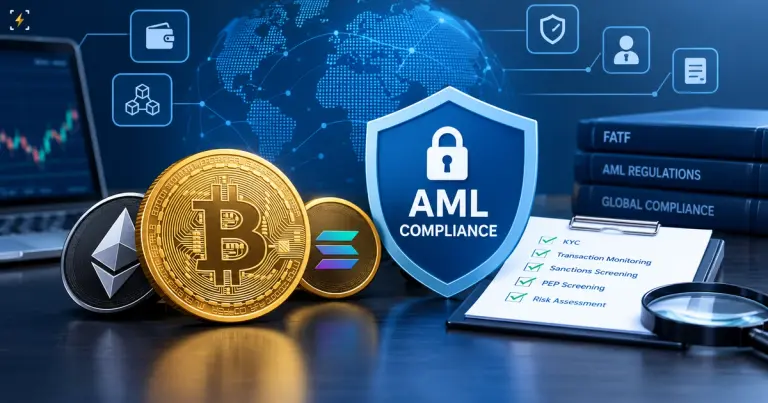
What is crypto AML compliance? A guide for cryptocurrency
Cryptocurrency has created faster ways to move value across borders. It has also created new challenges for financial crime compliance. Crypto exchanges, wallet providers, payment businesses, and other VASPs need to understand where funds come from, who controls accounts, and how transactions move. This is where AML crypto compliance becomes important. Traditional AML controls still matter, but crypto businesses also need to consider wallet activity, blockchain transactions, unhosted wallets, and fast-moving transfers. The Financial Action Task Force (FATF) has applied its AML/CFT standards to virtual assets and virtual asset service providers through Recommendation 15. Its latest 2026 update also highlights growing risks involving stablecoins, P2P transactions through unhosted wallets, and crypto-enabled fraud. For crypto businesses, compliance is becoming part of building a trusted and sustainable financial operation.
Why AML Crypto Compliance Matters for Digital Asset Businesses
Crypto transactions can flow from exchanges, private wallets, and decentralised platforms to various jurisdictions. This can complicate compliance teams' ability to grasp the complete context of a transaction. This is a risk, especially in consideration of the growing crypto market. FATF reported in March 2026 that more than 250 stablecoins were in circulation by mid-2025, with a combined market capitalisation above $300 billion. This development provides additional opportunities for legitimate financial transactions, but it also raises the need for good controls. Secure aml crypto compliance enables businesses to spot questionable customers and transactions while staying risk-based. Customer due diligence, suspicious transaction reporting and ongoing monitoring continue to be integral components of the broader AML landscape.
But for other VASPs, like exchanges, onboarding customers is not the only thing to focus on. Risk can vary during the course of the relationship.
How AML in Crypto Connects With Wallet and Transaction Risk
Facial screening doesn't provide a complete picture for a crypto business. A customer can pass an initial check and later interact with a wallet associated with suspicious activity. That is why AML in crypto should not just be limited to customer details. Other risk indicators include fund movements, transaction patterns, counterparties, and wallet addresses. FATF has recently identified the use of P2P transactions between unhosted wallets as an emerging risk. The report also highlights the misuse of stablecoins and the increasing industrialisation of frauds using cryptocurrencies and tokens for the 2026 edition. AML Watcher enables crypto companies to implement wallet screening and transaction monitoring in addition to other AML controls. Its crypto offering includes 10,000+ customizable risk rules, 150+ AML typologies, real-time transaction monitoring, and sanctions screening. This kind of connected approach allows compliance teams to evaluate activity within the context rather than as discrete transactions.
Building Stronger Crypto AML Controls With Better Data
The quality of currently available data is crucial to crypto compliance. A screening system that does not capture the appropriate sanctions information and/or only offers entity context information can add more work for analysts. AML Watcher integrates screening and monitoring in a single platform. It has over 100,000 sources, 3,500+ watchlists, and 235+ countries and states in its proprietary database. The company says it rechecks sanctions data every 15 minutes. This broader scope helps crypto enterprises conduct customer screening, wallet checks, sanctions monitoring, and continuous risk assessment within the same compliance system. It also allows for a reduction in the need to move from one system to the other when investigating a potential risk.
Crypto AML Compliance Needs Ongoing Monitoring
Risk profile may shift very rapidly for a crypto customer. Unusual transaction behaviour, sanctions designations or connections to risky entities may manifest after onboarding. It is an important consideration for crypto businesses to keep a close watch on it. A one-off customer check does not offer sufficient visibility in a month or year of repeat transactions. According to the 2026 FATF update, major implementation gaps in compliance with Recommendation 15 remain around the world. These weaknesses include identifying VASP activity, risk mitigation, licensing, supervision, and enforcement. Technologies can be useful to regulated businesses to make continuous controls more feasible. Patterns can be identified through transaction monitoring, and customer and wallet risks are monitored by screening. AML Watcher is an integrated solution for ongoing monitoring, sanctions, PEP, adverse media and watchlist, and transaction monitoring. This provides compliance teams with a more comprehensive understanding of customer and transaction risk.
Creating a More Connected AML Crypto Environment
Crypto businesses do not operate in a single risk environment. Customer identity, wallet activity, transaction behaviour, sanctions exposure, and adverse information can all affect the same relationship. This is why all crypto compliance works better when these signals are connected. Separate tools can leave analysts searching for context. A unified platform can bring relevant information closer to the investigation process. AML Watcher is designed to support banks, fintechs, crypto firms, and other financial businesses with screening, monitoring, and risk intelligence in one environment. Its crypto capabilities include wallet screening, transaction monitoring, ongoing monitoring, and custom risk scoring. For exchanges, VASPs, payment providers, and other digital asset businesses, stronger AML controls can support growth while reducing exposure to financial crime. Explore AML Watcher to strengthen crypto AML compliance with connected screening, wallet intelligence, and transaction monitoring.
Guest material. The text and the links inside it belong to the author; it is not investment or legal advice.

Author
Ethan LewisСontent writer
SEO content writer with 5+ years of experience in SaaS and product-based content, specializing in SEO, AEO, and GEO strategies. He has helped numerous businesses grow their online visibility through engaging, search-optimized content that drives digital growth
Comments (0)
No comments yet — be the first!
Join our community
No spam, unsubscribe in one click
Related articles

AI tools catalogue: 54 companies by job
Our AI catalogue holds 54 companies across 10 jobs, 187 pricing plans and a checked date on every price. Here is what is inside and how to search it.

Asset blocking: who can freeze your crypto funds
Exchanges, stablecoin issuers and courts can all restrict access to crypto. Who holds that power, why they use it, and what a frozen user can actually do.

Crypto regulation: how licensing grew and where it leads
From the 2013 FinCEN guidance to 789 permissions across six regimes: how crypto licensing was built, what it costs to enter, and a pessimistic ten-year reading.
Most readTop 7

Silicon Valley Workers Are Wearing Noise-Cancelling Masks to Dictate AI Prompts
368AI

