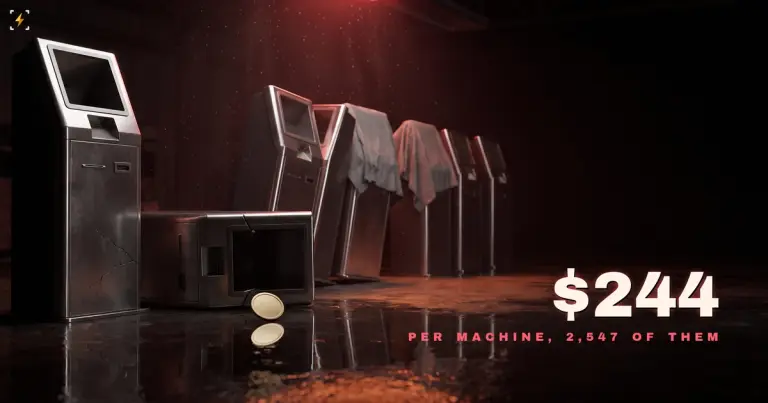
A quarter of the biggest crypto ATM network cost $244 a machine
A quarter of the largest crypto ATM network in the United States changed hands this week for less than the price of a two-bedroom flat, CoinDesk reports from court records. These machines take banknotes and hand back bitcoin, so every purchase leaves a record on the blockchain while the cash that paid for it leaves none. Divide the payment by the machines and each one went for $243.72.
How the price got there:
- First quarter: revenue down 49% year on year, and a $12.2 million profit turned into a $9.5 million loss.
- May: Bitcoin Depot files for Chapter 11 protection with more than 9,200 kiosks.
- This week: court records show 2,547 of those kiosks sold to Bitcoin Bancorp for $620,750.
Bitcoin Depot's own books put its property and equipment above $26 million in the fourth quarter of 2025, with 98% of that being the kiosks. Spread across more than 9,200 machines, that is roughly $2,800 a kiosk on the balance sheet, so the winning bid came in under a tenth of the carrying value.
The buyer paid another $110,500 for the floorspace agreements, the intellectual property, the trademarks, the patents and the BitcoinDepot.com domain. That is a fifth of what the hardware cost, for everything that made the hardware a business.
Bitcoin Bancorp, the buyer, was called Bullet Blockchain until recently and trades at four cents a share on OTC Markets with a market value near $18.5 million. Bitcoin Depot peaked around $400 million on the Nasdaq, so the company taking over the machines is worth about a twentieth of what the company losing them once was.
The rules the chief executive blamed
Alex Holmes, the Bitcoin Depot chief executive, blamed the rules rather than the market when the business went under.
“States have imposed increasingly stringent compliance obligations, including new transaction limits, and in some jurisdictions, outright restrictions or bans on BTM operations.”
— Alex Holmes, CoinDesk, 10 September 2026
Alex Holmes, Bitcoin Depot, quoted by CoinDesk, 10 September 2026
The rules did not arrive unprompted. Losses to crypto ATM fraud in the United States reached $389 million in 2025, up 58% on the year before, which works out at about $246 million in 2024. The pattern behind those numbers is consistent: someone builds a relationship online, invents an emergency, and directs the victim to feed cash into a machine.
Britain's Financial Conduct Authority declared these machines illegal several years ago, and regulators in Australia and Canada have tightened since. Washington and London signed a joint pact against scam compounds last week, which is the same problem approached from the other end of the wire.
What $731,250 buys
Set the two figures side by side and the sale looks less like a bargain than a clearance. A quarter of the biggest network in the country cost $731,250 in total, while the fraud running through machines like it cost Americans $389 million in a single year, a ratio of about 532 to one.
Bitcoin Bancorp says the remaining closings should finish during the coming quarter. Whether a fleet that a Nasdaq-listed operator could not run profitably works better for a four-cent stock is the question the next earnings report answers. Crypto bankruptcies have a habit of Chapter 11 filings that end in someone else owning the assets and the same economics underneath them.
Nothing here should be taken as financial advice; treat it as information to consider.

Author
MaksTrading man
I've been interested in the cryptocurrency market for a long time, am a trader, and write articles and news about my experience and crypto in simple terms.
Comments (0)
No comments yet — be the first!
Join our community
No spam, unsubscribe in one click
Related news


Most readTop 7

Silicon Valley Workers Are Wearing Noise-Cancelling Masks to Dictate AI Prompts
380AI

