Nvidia's supply chain is the first customer of Nvidia's own AI stack
Nvidia and Palantir announced a joint AI stack for supply chains today, and named its first deployment: Nvidia's own operations. The proof of the product is the co-seller buying it.
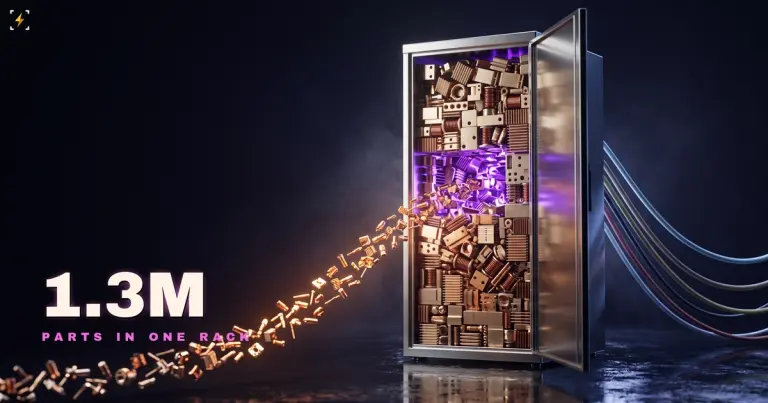
That is not a criticism by itself. Nvidia's supply chain is a genuine optimisation problem, and the press release puts a number on it: each Vera Rubin rack contains 1.3 million parts, drawn from thousands of suppliers, and a rack only ships when compute, memory, networking, power, cooling and mechanical components all arrive together. Finding which one of those is the binding constraint this week is exactly the sort of question a solver is for.
Six vendors in the sovereign stack
The word doing the marketing work is sovereign. Here is what the sovereign stack consists of:
- Nvidia: the Nemotron open models, the cuOpt optimisation software, and the hardware underneath.
- Palantir: the Foundry platform, the AI Platform on top of it, and the Ontology that grounds both.
- Infrastructure: Dell, Cisco, Rackspace and Nebius.
Count the vendors and you get six. The pitch is that a company should run models on its own data instead of handing its knowledge to a third-party provider, and what the customer gets is data that stays in its own systems while the model, the optimiser, the platform, the ontology and the metal all belong to somebody else. Sovereignty over the data, not over the stack.
A claim you can check
Alex Karp, Palantir's chief executive, made a claim in the release that is checkable.
“NVIDIA has arguably the most valuable, intricate and complex supply chain in the world. Our sovereign stack, powered by Nemotron models and Ontology, is delivering capabilities that exceed the frontier while providing alpha protection qualities unavailable otherwise.”
— Alex Karp, NVIDIA newsroom, 10 September 2026
Alex Karp, Palantir, in the Nvidia newsroom, 10 September 2026
Take exceed the frontier literally and check it against the leaderboards. Nemotron 3 Ultra was the strongest open US model when it launched in June, by Artificial Analysis's reckoning, and Inkling from Thinking Machines Lab has since taken that place. The base model of a stack said to exceed the frontier lost its own category inside about three months.
That is the durable problem with building on open weights. The customer post-trains on its own data, which takes time and money, and the model underneath it keeps aging in public. Whether a fine-tuned Nemotron beats a fresher rival on the customer's actual task is a different question from a leaderboard, and neither company answers it here.
Free models, paid everything else
Jensen Huang's own line is the more careful one. He calls supply chains the operating system of the physical economy and describes the work as turning an operational graph into intelligence that reasons, plans and orchestrates the journey from wafer to token.
Anthropic's Dario Amodei argued in August that open models mostly shift power to whoever owns the chips, and this deal is a clean illustration. The models are free, and everything they run on is not. Brussels ran into the same shape when it found €30 billion for AI sovereignty and spent it on American silicon.
Palantir shows the stack in detail at its AIPCon conference. Watch there for one thing: whether any customer outside Nvidia has put a supply chain on this stack.
This piece is informational, not a recommendation to buy, sell, or hold any asset.

Author
MaksTrading man
I've been interested in the cryptocurrency market for a long time, am a trader, and write articles and news about my experience and crypto in simple terms.
Comments (0)
No comments yet — be the first!
Join our community
No spam, unsubscribe in one click
Related news


Most readTop 7

Silicon Valley Workers Are Wearing Noise-Cancelling Masks to Dictate AI Prompts
380AI

