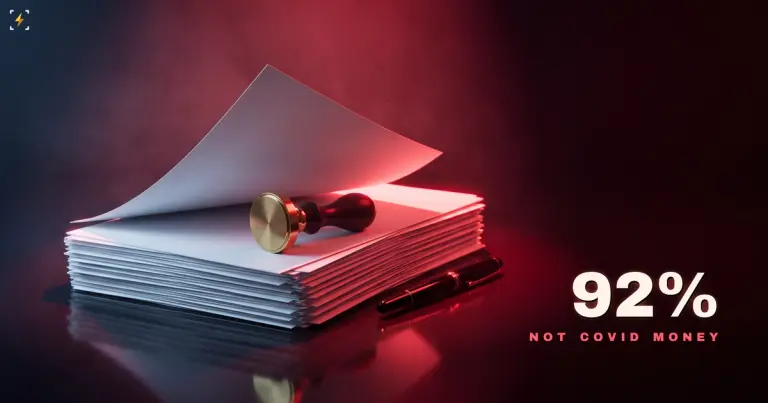
The pandemic loans were 8% of it. Rent rolls were the rest
A federal grand jury in Arizona indicted Rodney Rosenstein, 58, of Huntington Beach, California, on two conspiracy counts, and a judge ordered him held without bond. The Daily Hodl reported the case, citing the US Attorney's Office for the District of Arizona.
The number in every headline is $37.9 million, and the words attached to it are pandemic relief. The pandemic relief part is 7.7% of the total.
Where the $37.9 million actually came from
Prosecutors describe three stages, and the sizes are wildly uneven.
- $2.9 million from 15 loans under the Paycheck Protection Program, allegedly obtained with forged employment tax forms and W-2 documents. That averages $193,333 a loan.
- More false payroll records after that, allegedly used to have those same loans forgiven.
- $35 million in ordinary commercial loans, allegedly obtained by giving banks falsified rent rolls.
So $35 million of the alleged $37.9 million, or 92.3%, came from commercial lenders in the ordinary course of business. The emergency programme everyone will name in the headline accounts for one twelfth of it.
The document that did the work
A rent roll is a plain document: a list of a building's tenants, what each pays, and how long the leases run. Commercial lenders size a loan against it, because it is the evidence that a property produces income.
Nobody needs an emergency to abuse that. There was no rushed programme, no waived checks, no crisis deadline. Just a document that a bank has to trust, handed over by someone the bank has no way to audit in the moment.
The programme side had its own design problem. A loan under that scheme could be forgiven if the borrower showed the money went to payroll, which turned a fraudulent loan into a grant if the second set of papers held up. The indictment alleges exactly that second set.
Why a crypto site is running this
There is no cryptocurrency anywhere in this case. We are writing about it because the mechanism is the one the industry keeps promising to remove: a document nobody can verify at the moment of decision.
Tokenised real-world assets are sold on precisely that promise, and we measured the sector this morning. A rent roll written to a blockchain, where a lender can check it independently instead of trusting a printout, is the plain version of what tokenisation claims to deliver. Whether the industry delivers it is a separate question, and $35 million of alleged paper says the problem is worth the effort.
We covered an $80 million Ponzi case with no coins in it last week for the same reason. The absence of crypto is the point: these are the failures the technology is supposed to address, and they are still happening at scale.
The loan fraud charges
The bank fraud conspiracy count carries up to 30 years in prison and a $1 million fine. The false statements count carries up to five years and $250,000. The investigation ran through the FBI Phoenix Division's Tucson office, IRS Criminal Investigation and the Federal Housing Finance Agency Office of Inspector General.
An indictment is an accusation and nothing more. Rosenstein has not been convicted of anything, and the allegations remain to be tested in court.
This piece is informational, not a recommendation to buy, sell, or hold any asset.

Author
MaksTrading man
I've been interested in the cryptocurrency market for a long time, am a trader, and write articles and news about my experience and crypto in simple terms.
Comments (0)
No comments yet — be the first!
Join our community
No spam, unsubscribe in one click
Related news



Most readTop 7

Silicon Valley Workers Are Wearing Noise-Cancelling Masks to Dictate AI Prompts
379AI

