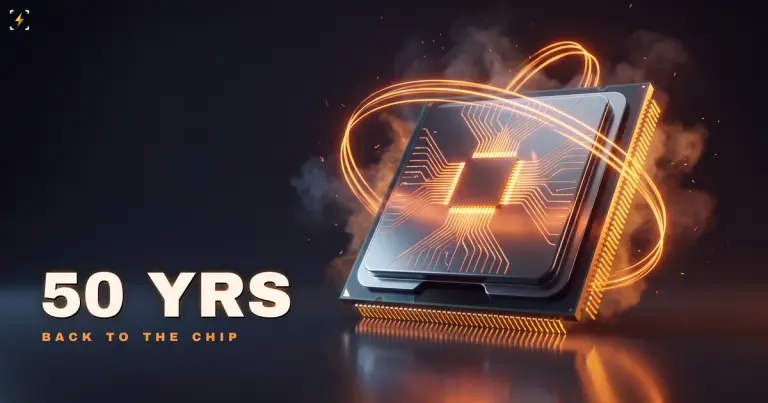
Chips throw away energy as heat. She treats that as a choice
Every chip you own throws away energy as heat, and the industry has treated that as the price of doing arithmetic since the beginning. Hannah Earley, 31, thinks it is a design choice. MIT Technology Review profiled her today as one of its innovators under 35.
She is cofounder and chief technology officer of Vaire Computing, which builds chips that recover the energy other chips discard.
“It's clear they have something interesting. The company will need a series of increasingly realistic and convincing demonstrations to attract the industry support needed for commercialization.”
— Igor Markov, electronic design automation researcher, MIT Technology Review, 8 September 2026
Quote source: Igor Markov, researcher in electronic design automation, MIT Technology Review, 8 September 2026
Why chips get hot in the first place
A conventional processor erases information it no longer needs at every step of a calculation, and erasing a bit costs energy that leaves as heat. That is not an engineering sloppiness anyone can polish away, it is physics: Landauer's principle sets a floor on what deleting information costs.
Earley's own comparison is driving through a city and braking at every intersection. The car loses momentum, then burns fuel getting it back. Reversible computing keeps the intermediate steps instead of deleting them, so the calculation can be run backwards and part of the energy recovered.
The idea is more than fifty years old and has spent almost all of that time on paper, because nobody could build it with ordinary transistors.
What reversible computing has actually shown
Earley designed a new component to make it work: a patent-pending resonator, a microscopic part that stores recovered energy until it is needed again. She calls it a glorified pendulum, which is close to literally true.
Last year Vaire reported the result that matters. A chip with that resonator recovered more energy than it lost, and the figure held after subtracting the energy needed to run the resonator itself. For a field that had existed mainly as theory, that was the first sign of life.
The company has raised more than $12 million and hired Michael Frank, whose 1999 doctoral thesis on reversible computing is what pulled Earley into the subject in the first place. Her supervisor at Cambridge, the computational biologist Gos Micklem, had sent it to her a few months into a PhD about computing with DNA. She read it, was sceptical, read it again, and changed her research.
Micklem later stopped putting his name on her papers, telling the magazine he could not have stood up and given a proper talk about them. The work was hers.
Against 14.8 gigawatts of signed contracts
Set this against what the industry committed to this year. Anthropic alone has booked 14.8 gigawatts of compute since October, and a single campus like the one we wrote about this morning draws up to 500 megawatts when finished. Every one of those watts becomes heat, and cooling it is a second energy bill on top of the first.
A technology that recovers part of that at the transistor level attacks the problem underneath the problem. It also arrives roughly a decade too late to change any contract signed in 2026.
Crypto mining has priced computation in electricity since the first bitcoin block, which is why a chip that hands energy back would land there before it lands in a phone. The economics are already written in kilowatt hours.
Markov's caution is the right frame. What exists is a lab result, not a product, and the next task is unglamorous: making a fundamentally different chip fit inside factories and devices built for the ordinary kind. Watch for the second and third demonstrations rather than the first.
Nothing here should be taken as financial advice; treat it as information to consider.

Author
MaksTrading man
I've been interested in the cryptocurrency market for a long time, am a trader, and write articles and news about my experience and crypto in simple terms.
Comments (0)
No comments yet — be the first!
Join our community
No spam, unsubscribe in one click
Related news


Most readTop 7

Silicon Valley Workers Are Wearing Noise-Cancelling Masks to Dictate AI Prompts
379AI

