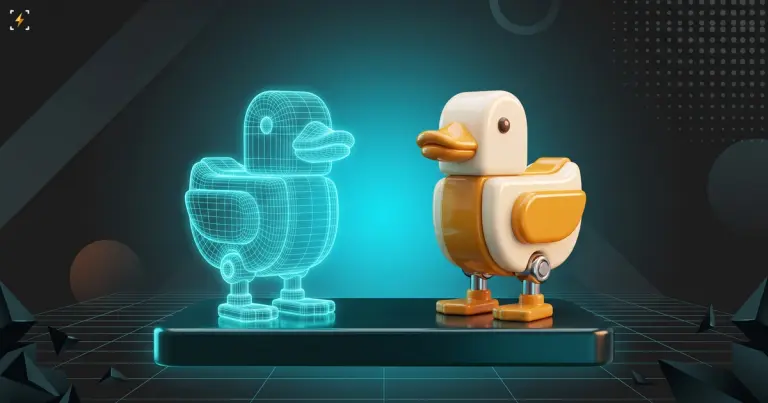
Nvidia trained the $399 Microduck robot in simulation
Nvidia published a walkthrough on 23 October showing how it taught a small robot to cross an obstacle course without the robot being in the room. The subject is Microduck, a 25cm two-legged duck built by Pollen Robotics with Hugging Face. Five Nvidia engineers ran the planning and the 3D asset work through a chain of models, each AI agent taking one step of it, assembled the course in Isaac Sim, and trained the walking policy in Isaac Lab across 4,096 parallel simulated worlds on a single RTX PRO 6000 workstation card.
“Training utilized 4,096 parallel environments on an NVIDIA RTX PRO 6000 Blackwell Workstation Edition GPU.”
— Nvidia developer blog, 23 October 2026, https://developer.nvidia.com/blog/using-ai-agents-to-teach-robots-like-microduck-to-walk-in-simulation/
The robot it was all aimed at costs $399. Microduck is a research machine on paper: 15 motors, a front camera, a depth sensor and two inertial measurement units in something under a kilogram. In practice it walks, sits, stands, does somersaults, gets up after a fall and picks up light objects with its beak, and a $129 expansion kit adds servos and sensor headers. There is also a roller-skate attachment, which tells you something about who the buyer turned out to be.
137 stars a day against five
Demand is the part worth measuring rather than describing. The first batch sold out, and the next one is advertised as shipping by Christmas in North America and Europe. The company has published no unit numbers, so we counted the thing that is public: on 26 October the Microduck repository held 12,216 stars and 1,530 forks, and it was created on 29 July. That is 89 days and roughly 137 stars a day.
Put it beside the project it descends from. Open Duck Mini, the community attempt to build a miniature BDX droid at home, has 4,513 stars after 894 days, about five a day. Microduck has 2.7 times as many stars in a tenth of the time, and it picked up stars 27 times faster. Hugging Face's own robotics library, which has been the centre of this scene for nearly three years, sits at 28,486.
Whether children want one is not something anyone has measured, and we are not going to pretend otherwise. What is on the record is a sold-out first run, a Christmas shipping promise, four colours to choose from and a duck that roller-skates. Pollen Robotics sells it as a reinforcement learning platform; the roller skates were not an accident.
The expensive part is the duck
The useful part for a parent is the same point we made about the Nvidia robot stack yesterday. The software a child would use to teach this duck a new move is Isaac Lab, the same framework in the Nvidia post, free and open. The duck is the expensive part, and the simulator where the walking is actually learned runs without one.
Informational material, not investment advice. Pollen Robotics has published no sales figures, the star counts are our own reading of GitHub on 26 October 2026, and repository stars measure attention rather than purchases.

Author
MaksTrading man
I've been interested in the cryptocurrency market for a long time, am a trader, and write articles and news about my experience and crypto in simple terms.
Comments (0)
No comments yet — be the first!
Join our community
No spam, unsubscribe in one click
Related news


Most readTop 7

Silicon Valley Workers Are Wearing Noise-Cancelling Masks to Dictate AI Prompts
380AI

