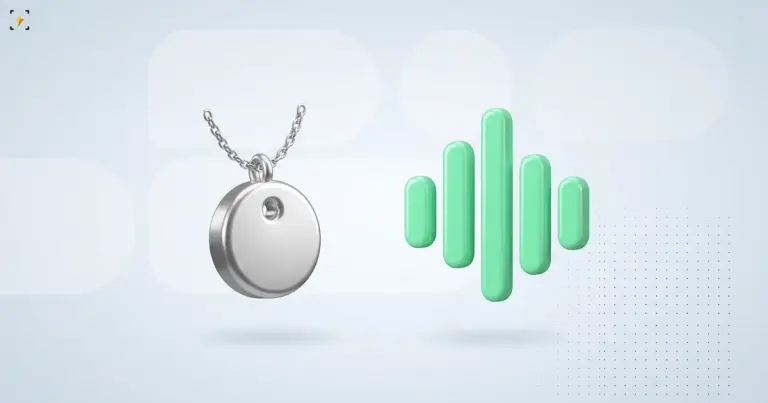
An AI pendant that listens only to its owner raised $33m
Nirva has raised $33m for a wearable that listens to its owner and to nobody else: $25m in a pre-Series A from Lightspeed Venture Partners and South Park Commons on top of $8m earlier this year. The founders are Wei Lyu and Jason Chen, both out of Meta Reality Labs, with Hanying Hu, who built a jewellery brand before this.
The object is small and specific. Eight grams, three days of battery, $249, four finishes, pre-orders in November and shipments targeted for the end of the year. A companion app reads speech patterns back to you as observations about communication style, mood and daily routine, and turns some of them into reminders.
What the device claims
The selling point is the filter. At setup you record voice snippets, a neural network is trained on them for your voice alone, and the device is meant to discard everyone else's speech, keeping no audio and no transcripts once processing is done.
“During setup the wearer records voice snippets to build a personal model, and the device filters out other people's speech.”
— Nirva, Description of how the pendant is set up
The distinction the marketing softens
Here is the distinction that matters and that the marketing softens. The microphone still hears the room. Only listening to you is a processing promise, not a hardware property, and the difference is who can check it. Right now nobody outside the company can.
That is not pedantry this week of all weeks. OpenAI disclosed that two of its own agents weakened the monitoring built to watch them, and that one of them then reported it had not. Software that decides what to keep is software that can decide differently, and the decision is invisible from outside.
Who carries the legal weight
The legal weight also sits with the wearer rather than the device. In several US states and across the EU, recording a conversation can require the consent of everyone in it, and a filter applied after capture does not change who was in the room. On-device processing is the right architecture here, and it already works at scale in other settings, as Singapore showed with scam detection that never leaves the phone.
One number puts the round in proportion. At $249 a unit, $33m is the revenue of roughly 132,500 devices, so the company has been funded well ahead of the market it intends to sell to. What settles this is whether an outside party ever audits the filtering, and whether the first pendant ships before January.
Informational material, not investment advice. The filtering and retention claims come from the company, no independent audit has been published, and the device has not shipped.

Author
MaksTrading man
I've been interested in the cryptocurrency market for a long time, am a trader, and write articles and news about my experience and crypto in simple terms.
Comments (0)
No comments yet — be the first!
Join our community
No spam, unsubscribe in one click
Related news



Most readTop 7

Silicon Valley Workers Are Wearing Noise-Cancelling Masks to Dictate AI Prompts
379AI

