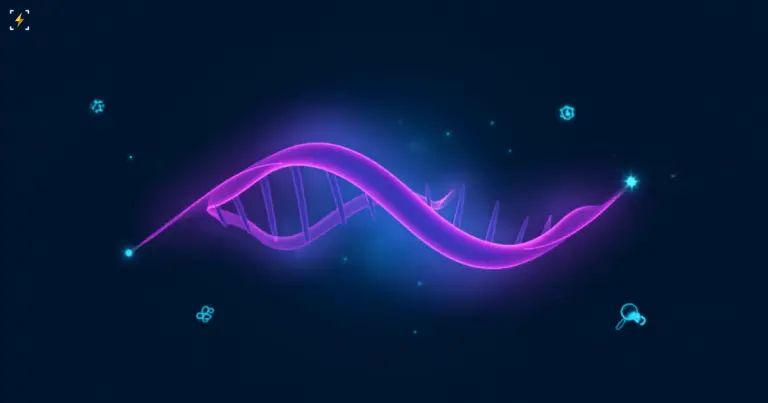
Claude's AI agents can run real protein-folding experiments
Nvidia and Anthropic connected Nvidia's BioNeMo Agent Toolkit to Claude Science, Anthropic's AI research workbench, Nvidia detailed, letting Claude's agents discover, launch, and call specialized biology and chemistry models on their own instead of needing a researcher to wire each one up by hand.
- BioNeMo Agent Toolkit packages over a decade of Nvidia life-science models into agent-callable skills for biology, chemistry, genomics, and drug discovery
- On Nvidia's internal benchmarks, BioNeMo skills raised task correctness from 60% to 100% and roughly doubled token efficiency
- Demo workflow: three NIM microservices, msa-search, OpenFold3, and Boltz-2, run a protein-folding prediction end to end
- Hardware requirement: a workstation or cloud machine with an Nvidia L40S or H100 GPU and about 700 GB of storage
- The toolkit is open source on GitHub
The published demo tests a real structural question. Claude Science built evolutionary alignments for the fungal protein Seh1 and an uncharacterized proposed partner, C1HCX1, then folded each one alone and as a pair using two independent models, OpenFold3 and Boltz-2. Nvidia and Anthropic explicitly instructed the agent to stop and report rather than fake a result: if the required paired alignment failed, the prompt told it not to quietly substitute a different kind of input.
The alignment step turned out to matter more than anything else. Without it, the models' confidence in whether the two proteins actually touch collapsed, from 0.85 to 0.14 for OpenFold3 and from 0.82 to 0.19 for Boltz-2. With the alignment, both models, built on different architectures, converged independently on the same answer: a cluster of partner-protein strands completing Seh1's open propeller shape at the same structural position. That result matches a real, previously published finding from a March 2026 bioRxiv paper on the AlphaFold Database's proteome-scale structures.
Two independent models converged on the same local geometry, creating a compelling hypothesis rather than proof of binding.
The integration is part of a broader push to give AI agents domain tools instead of just chat. Intokened has tracked the same shift in software this week: shared sessions for coding agents, and rising token usage as agents take on more of the actual work rather than just answering questions.
Nvidia and Anthropic are careful to say what the workflow doesn't prove: two AI models agreeing on a protein's shape is a hypothesis, not a discovery. Confirming it experimentally is still someone's job in a wet lab, not a GPU's, no matter how well the models agree with each other.
Nothing here should be taken as financial advice — just information to consider.

Author
MaksTrading man
I've been interested in the cryptocurrency market for a long time, am a trader, and write articles and news about my experience and crypto in simple terms.
Comments (0)
No comments yet — be the first!
Join our community
No spam, unsubscribe in one click
Related news

Tampered Ledger devices mailed the seed phrase and drained $4.8m in bitcoin
Top 10 altcoin gainers of the last 48 hours and what each project does
Capital B lost $78m in the first half, and 97% of it was an impairment
Most readTop 7

Silicon Valley Workers Are Wearing Noise-Cancelling Masks to Dictate AI Prompts
369AI

