PayPal will back your stablecoin, and PayPal will not accept it
PayPal has opened PYUSDx, a platform that lets companies issue their own stablecoins backed by PayPal USD, CoinDesk reports. It was built with M0 and MoonPay, previewed in February, and three issuers are live: Saturn, Concrete and Cap, with more than $100 million of processing volume between them.
One line in the announcement does most of the work. PYUSDx coins are separate from PayPal's own stablecoin, and PayPal and Venmo wallets do not support them.
“PYUSDx tokens are separate from PayPal's native stablecoin and are not supported within PayPal or Venmo wallets.”
— PYUSDx announcement, CoinDesk, 9 September 2026
Quote source: the PYUSDx announcement, via CoinDesk, 9 September 2026
A consumer reading that a PayPal-backed stablecoin has launched would expect to spend it inside PayPal. They cannot. This is business infrastructure wearing a consumer brand, and the distinction is the whole product.
What the issuer gets to choose
The issuer picks three things:
- Name, symbol and control features.
- Reserve composition.
- The reward distribution model, meaning who receives the yield the reserve earns.
That third item is the one regulators are circling. On 1 September we wrote about Singapore proposing 100% reserves and a ban on paying yield to stablecoin holders. PYUSDx makes the yield split a configuration setting, and any jurisdiction that outlaws it removes the setting.
The size of it
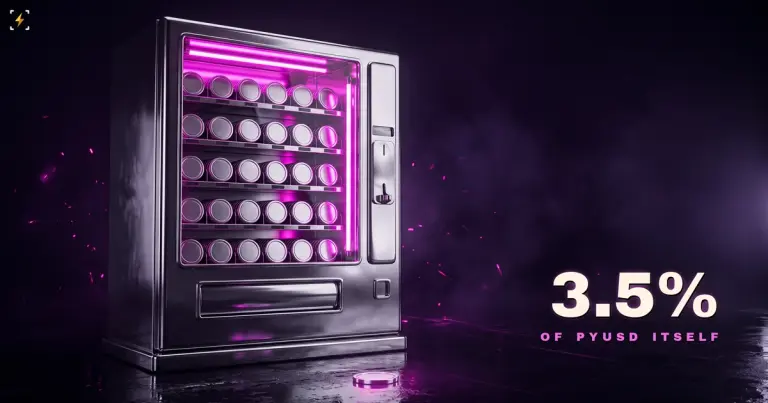
Three issuers and $100 million of volume put this at 3.5% of PYUSD's own $2.82 billion market value, and at 0.5% of the $20 billion annualised stablecoin settlement Visa reported this week. The average issuer is running about $33 million.
Note what backing means here. Someone holding one of these coins has a claim on the issuer, whose reserve is PYUSD, which is itself a claim on PayPal's dollars. Two layers sit between the holder and the money, and each layer has its own operator.
PYUSD itself is the smaller story inside a small story. Tether carries $183 billion and USDC $74 billion, against PYUSD's $2.82 billion. PayPal's stablecoin is roughly 1.5% of Tether.
The speed claim is the credible part. Going from test to launch in days rather than months is a real change for a company that wants a branded coin and does not want to run reserve management, redemption or attestations itself.
That is also what PayPal is selling. Not a coin, but the reserve, the plumbing and the compliance surface underneath somebody else's coin.
The pattern this belongs to
We wrote yesterday about Visa wiring VisaNet into onchain credit at 0.14% of its network. The same shape appears here: a payments giant building stablecoin infrastructure at a scale that rounds to nothing against its own core business.
Both are worth watching for the same reason. The infrastructure is being laid now, at volumes small enough that a failure costs little, which is exactly when this kind of thing gets built.
Nothing here should be taken as financial advice; treat it as information to consider.

Author
MaksTrading man
I've been interested in the cryptocurrency market for a long time, am a trader, and write articles and news about my experience and crypto in simple terms.
Comments (0)
No comments yet — be the first!
Join our community
No spam, unsubscribe in one click
Related news



Most readTop 7

Silicon Valley Workers Are Wearing Noise-Cancelling Masks to Dictate AI Prompts
379AI

