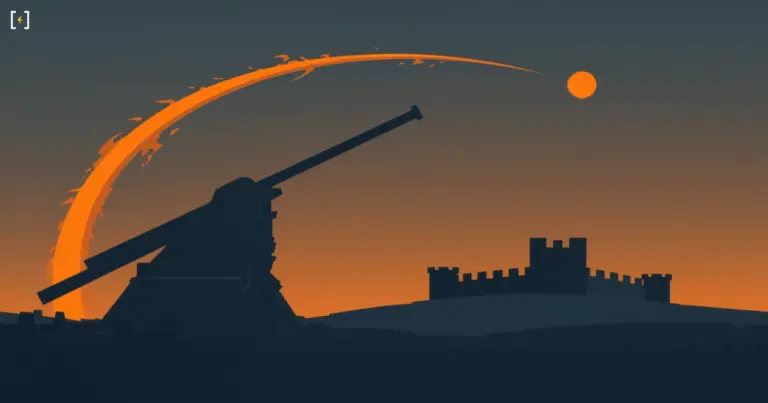
Scientists identify history's only known trebuchet casualty
A rock travelling close to 300 kilometers an hour slammed into a defender's upper back during a medieval siege, shattering his skull in 61 places and crushing him beneath its weight. Seven hundred years later, forensic analysis of his skeleton has confirmed what actually hit him: he is, as far as researchers can tell, the only person in history conclusively identified as a trebuchet casualty. University of Bradford paleopathologist Jo Buckberry presented the findings at the 25th European Meeting of the Paleopathology Association, Ars Technica reported.
The skeleton, catalogued only as Skeleton 150, was one of nine sets of remains found beneath the chapel of Scotland's Stirling Castle during renovation work in 1997. Five of the nine showed clear signs of violent death, but Skeleton 150 stood out: his skull had broken in 61 separate places, another 60 fragments were scattered across his ribs, his right shoulder was broken, and his right leg was shattered above the knee. Buckberry's team threw forensics, microscopes, X-rays, and micro-CT scans at the case, and all of it pointed to a single moment of crushing impact from something heavy and fast, striking his shoulder and the back of his head while pinning him to the ground hard enough to crack his ribs under the weight.
The injuries ruled out the usual grim possibilities of a medieval siege on their own: the bones broke while still fresh, so this wasn't a corpse struck after death, and the force involved was too great for a horse trampling, a cart, or even a fall from the castle walls, whose angle didn't match the wound pattern either. “The most similar cases I was finding were car crashes and people hit by trains,” Buckberry told Science.org's Andrew Curry. “What is large and moving very quickly in 1304?” The answer, once she asked the question that way, was a boulder flung by one of the thirteen siege engines bombarding Stirling Castle at the time.
“It highlights the brutality of medieval warfare.”
— Jo Buckberry, paleopathologist, University of Bradford
A typical trebuchet of the period could launch a roughly 90-kilogram stone a few hundred yards; medieval trebuchet physics calculations put the resulting impact speed at 200 to 300 kilometers an hour and just over 200 kilojoules of energy, in the range of a serious car crash. Siege engines were built to break walls, not people; injuries to individuals were normally incidental, from flying debris or collapsing masonry, since crews weren't aiming at defenders directly. Skeleton 150, in that sense, was simply in the wrong place when a badly-aimed or ricocheting shot found him.
- Skull broken in 61 places, 60 more bone fragments across the ribs, right shoulder broken, right leg shattered above the knee
- Forensics, microscopes, X-rays, and micro-CT scans all pointed to one crushing impact, not repeated trauma
- Impact force and angle ruled out a horse, a cart, and a fall from the castle walls
- Comparable in force to a modern car crash or being struck by a train, at roughly 200 to 300 km/h
Skeleton 150 was likely one of just 25 men still holding Stirling Castle under Sir William Oliphant by 1304, the last pocket of Scottish resistance after England's Edward I spent six years conquering the rest of the country following his victory over William Wallace at Falkirk in 1298. Edward stripped lead from church roofs across Scotland and hauled in stones and iron from Glasgow to build siege equipment, then bombarded the castle around the clock for three months with thirteen engines. He also built the largest trebuchet anyone had seen, nicknamed the War Wolf, and refused Oliphant's offer to surrender specifically so he could fire it anyway on the siege's final day, sending a 140-kilogram stone straight through the curtain wall. Buckberry's team thinks Skeleton 150 died earlier in the three-month bombardment rather than to the War Wolf itself, since that engine fired only once, while the other twelve had been in action for months by then.

Comments (0)
No comments yet — be the first!
The market talks all day. We write when it says something
Short, and it tells you why it came
Related news



Most readTop 7

Silicon Valley Workers Are Wearing Noise-Cancelling Masks to Dictate AI Prompts
334AI

