19 Days Banned: The US Has Lifted Export Controls on Anthropic's Fable 5 and Mythos 5
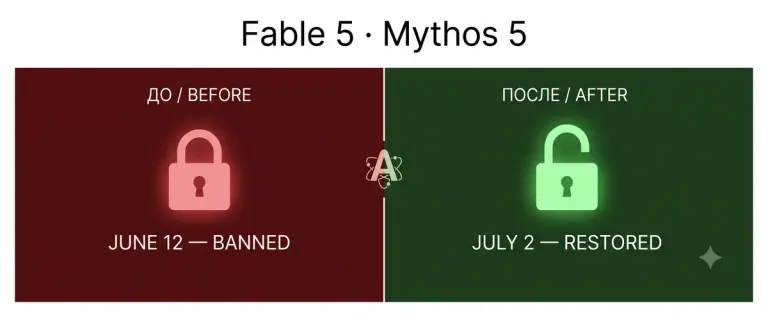
The US Department of Commerce has formally withdrawn export controls on Anthropic's Claude Fable 5 and Mythos 5 AI models — ending a 19-day standoff that had blocked global access to the company's most capable systems, Forbes reports.
Timeline of events
June 9, 2026: Anthropic publicly launched Claude Fable 5 — the company's newest flagship model.
June 12: The US Bureau of Industry and Security (BIS) ordered Anthropic to immediately cut off access to Fable 5 and Mythos 5 for all foreign nationals, including company employees. The official reason was national security concerns. It later emerged that the trigger was a discovered jailbreak technique: Amazon executives and NSA reviewers warned that the vulnerability could potentially turn the models into unrestricted cyber tools. Anthropic publicly disputed the scale of the threat, calling the issues "minor" and referring to already-known limitations, Al Jazeera reports.
June 26: Access to Mythos 5 was partially restored for select US organizations with government approval.
June 30: Commerce Secretary Howard Lutnick announced the full lifting of export controls. He said the department had "worked closely with Anthropic to analyze and approve Fable 5" to "strengthen America's leadership in AI." From July 2, Fable 5 became available globally — on Claude.ai, Claude Code and through the API, Axios reports.
Conditions of restoration
"The administration reserves the right to reimpose restrictions in the future if circumstances change or should Anthropic fail to adhere to its commitments" — Howard Lutnick, US Secretary of Commerce.
Anthropic agreed to proactively detect and address security vulnerabilities and to report malicious use to authorities. In effect, the company has taken on the role of a national security partner — in exchange for the right to freely distribute its models internationally.
Takeaway
The 19-day ban made one thing clear: powerful AI models are now regulated as strategic export goods — on a par with weapons and semiconductors. For businesses, this means that dependence on external AI services carries an infrastructure risk that was previously considered theoretical.
This article is for informational purposes only and does not constitute investment or technical advice.
Comments (0)
No comments yet — be the first!
The market talks all day. We write when it says something
Short, and it tells you why it came
Related articles

USDC: The dollar that Europe has allowed
$74bn in circulation and $19bn of daily turnover. Who stands behind USDC, what sits in its reserves, and why Europe let this coin stay but not USDT.

The Digital Euro: Europe's exit from non-EU payment schemes and the trust test that comes with It
Why the ECB is building its own payment rail, how it plans to keep payments private, and why trust decides whether any of it works.

How Tax Authorities Detect Undeclared Cryptocurrency Income
Why self-custody, DeFi and crypto cards do not make a person invisible, and how to restore PnL and correct tax history before an audit.
Most readTop 7

Silicon Valley Workers Are Wearing Noise-Cancelling Masks to Dictate AI Prompts
332AI

