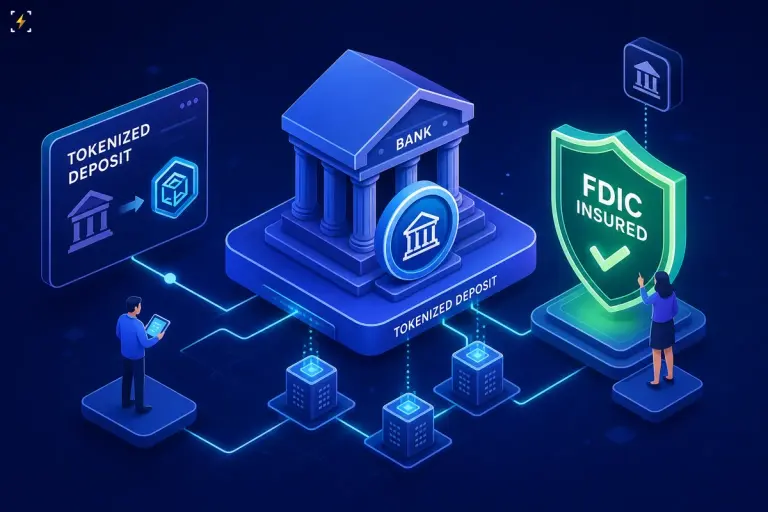
What is a tokenized deposit account and is it FDIC-insured?
A tokenized deposit account is a conventional bank deposit that exists and moves as a digital token on a blockchain or shared ledger. Your legal claim stays against the issuing bank, deposit insurance may still apply, and nothing about the underlying money changes. The only thing that shifts is the rail: instead of a legacy core-banking entry, your balance is represented on-chain, with programmability and near-real-time movement built in. That distinction separates it from a stablecoin, which is a private issuer's promise backed by reserves rather than a bank charter, and from a regular savings account, which generally lacks on-chain programmability or smart-contract-based conditional transfers.
In 2026, this is no longer theoretical. JPMorgan, Citi, HSBC, BNY, and SoFi all offer live products, though most are institutional or limited-access, and SoFi's SOFIE is the only broadly available U.S. consumer option, and U.S. regulators are actively writing the rules. If you have been following our coverage of tokenized finance here at Intokened, this topic has been building across multiple layers: regulation, product launches, and the technical architecture underneath. This article pulls it all together.
Key takeaways
- Still a bank deposit: A tokenized deposit account is your bank balance on a blockchain. The issuing bank still owes you the money, and FDIC coverage may apply up to $250,000 per depositor, per insured bank, per ownership category.
- Not a stablecoin: A stablecoin is a private issuer's redemption promise backed by reserves. It is generally not deposit-insured, even if reserves sit in a bank account.
- GENIUS Act matters: The 2026 GENIUS Act explicitly excludes deposits recorded on distributed ledgers from the stablecoin definition, preserving the bank's authority to issue deposit tokens.
- Retail access is limited: SoFi Earn (SOFIE) is the most widely available U.S. consumer product. Most other offerings are institutional-only.
- The FDIC rule is proposed, not final: A 2026 proposed rulemaking would confirm technology-neutral insurance treatment, but it had not been finalized as of this writing.
- Substance over ledger technology: In every major jurisdiction, what determines insurance and regulatory treatment is who owes you the money, not how the record is kept.
How a tokenized deposit differs from a stablecoin or CBDC
The three instruments can look identical at the technical level. A tokenized deposit, a stablecoin, and a CBDC can all live on Ethereum. What separates them is the issuer, the legal claim you hold, and the protections that attach to it.
- Tokenized deposit. Issuer and legal claim: Regulated commercial bank; claim on the bank. Backing and protection: Bank balance sheet; deposit insurance may apply depending on jurisdiction and structure. Main use case: Programmable, near-real-time payments and settlement within a regulated banking environment
- Stablecoin. Issuer and legal claim: Private issuer (fintech or bank); redemption claim against the issuer. Backing and protection: Reserves such as cash or short-term government securities; generally not deposit-insured. Main use case: Broad on-chain circulation, often through public blockchains
- CBDC. Issuer and legal claim: Central bank; direct claim on the central bank. Backing and protection: Central-bank liability; no commercial-bank credit risk. Main use case: Digital central-bank money for retail or wholesale payments
A stablecoin holder relies on the issuer's reserves and redemption policy. There is no bank charter, no deposit law, and no FDIC standing behind the token itself. A CBDC skips the commercial bank entirely: it is the central bank's own liability, not a claim routed through any private institution. A tokenized bank deposit preserves the two-tier monetary structure that underpins the existing financial system. Your bank still owes you the money; it just records and transfers that obligation on a programmable ledger.
Account-based vs. token-based: why the technical model matters
Most live products today use an account-based design. The deposit stays tied to your identified bank account. The token is a digital interface that triggers debits and credits, while the bank maintains the authoritative balance record. The bank can freeze, reverse, or screen transactions. HSBC Orion, Citi Token Services, and BNY all follow this model. Think of it as online banking with a blockchain back-end rather than a fundamentally new custody arrangement.
A token-based design departs more fundamentally from conventional banking. The token itself embodies the deposit claim and moves peer-to-peer. Whoever controls the private key can transfer it, similar to digital bearer cash. That creates faster, more composable settlement, but it also introduces key-management risk, harder AML enforcement, and recovery challenges if a wallet is compromised. If a wallet provider issues its own token against deposits it holds at a bank, your legal claim may stop at the wallet provider rather than the underlying bank.
The ledger choice adds another layer. A permissioned ledger restricts access to approved participants, making KYC, sanctions screening, and transaction limits easier to enforce. A public blockchain, such as Ethereum or Base, offers shared infrastructure where deposit tokens can settle atomically against other assets. JPMorgan's JPMD runs on this model, with compliance controls layered on top through whitelisted addresses and transfer restrictions built into the token contract. In practice, most current implementations are account-based on permissioned or bank-controlled platforms, the most conservative version of the technology, and precisely why regulated banks are comfortable deploying it.
Which banks offer tokenized deposit accounts right now?
Retail access remains limited. SoFi Earn (SOFIE) is the only broadly available consumer tokenized deposit account in the United States. Each SOFIE token equals a $1 deposit liability of SoFi Bank, earns a variable APY (SoFi reported 4.40% as of October 20, 2026, per its product support materials), and is FDIC-insured subject to applicable limits. Balances can convert one-for-one into SoFiUSD for 24/7 blockchain transfers and in-app crypto purchases. One important caveat: after conversion, the balance is no longer a bank deposit, stops earning SOFIE interest, and loses FDIC deposit insurance. Standard bank onboarding and identity verification are required to access the product.
On the institutional side, the field is more crowded but access is restricted. JPMorgan's JPMD runs on Ethereum and Base, backed one-for-one by deposits and redeemable into conventional funds; eligible clients need an approved JPMorgan Blockchain Deposit Account and full KYC/AML review. Citi Token Services targets cross-border liquidity management and automated securities transactions, designed to operate outside traditional banking hours. HSBC's Tokenised Deposit Service on its Orion platform supports multiple currencies, including USD, GBP, EUR, HKD, and SGD, on a private blockchain and extended availability to the United States in 2026. BNY offers on-chain book entries representing clients' existing demand-deposit claims, for institutional clients only.
Looking ahead, Swift's 17-bank tokenized-deposit payment platform and a planned U.S. bank consortium network involving JPMorgan, Citi, Bank of America, Wells Fargo, and others are targeting a 2027 launch through The Clearing House. These are not broadly available yet. Several other bank announcements remain in limited pilots rather than live deployments, and it is worth reading carefully before assuming a product is accessible.
What pilot programs have actually documented
The strongest evidence from live deployments and documented pilots focuses on settlement speed and operational efficiency. Project Agorá reported an average payment-initiation-to-settlement time of approximately 80 seconds in real-value testing. Hong Kong's Project Ensemble found that some tokenized-fund transactions could move from T+1 to T+0, with delivery-versus-payment completing in seconds. Faster finality reduces the time funds are tied up in transit, improves intraday liquidity visibility, and can lower the prefunding required before settlement.
Cost savings are reported but need to be read carefully. The BIS Inthanon-LionRock prototype estimated reductions of up to 50% in several correspondent-banking cost components, including nostro/vostro liquidity, treasury, compliance, FX, and intermediary fees. Other vendor and deployment claims run higher, but most lack independent transaction-level validation. Neither Project Agorá nor Project Ensemble quantified independently verified monetary cost savings in their final business-use-case reports. The operational gains are real; treat the cost figures as directional estimates rather than confirmed benchmarks.
For treasury teams, the use case is straightforward: real-time cash-position visibility, automated transfers, and more efficient management of nostro/vostro balances. For cross-border payments, multi-bank tokenized-deposit networks remove sequential correspondent-bank hops and support 24/7 workflows. Swift's ledger is an example of this model in pilot form. Programmable deposits also enable atomic delivery-versus-payment: asset and payment exchange in one coordinated transaction on the same chain, eliminating the manual reconciliation steps that follow conventional settlement.
FDIC insurance and the protections you should verify
How a tokenized deposit account is insured in the United States
A qualifying tokenized deposit can receive the same FDIC treatment as a conventional deposit: up to $250,000 per depositor, per insured bank, per ownership category. The decisive factor is not the ledger technology but whether you hold a direct legal claim on a chartered, FDIC-insured bank. The FDIC's 2026 proposed rulemaking (RIN 3064-AG19, published at 91 FR 18534) would codify this technology-neutral treatment and explicitly state that insurance does not depend on how the record is kept. As of this writing, the rule is not final. The comment period closed June 9, 2026, and FDIC Chairman Travis Hill indicated in October 2026 that additional attention may be needed before finalization.
The GENIUS Act provides clarity on the classification question. It defines a payment stablecoin as a digital asset redeemable for a fixed monetary value, and it expressly excludes deposits, including deposits recorded using distributed ledger technology, from that definition. A tokenized bank deposit stays a deposit under federal law. A stablecoin issuer's reserve deposit, by contrast, is not automatically an insured deposit for each stablecoin holder: the legal ownership and pass-through structure determine who the FDIC actually covers.
EU and UK treatment
In the UK, qualifying deposit tokens fall within Financial Services Compensation Scheme protection, with a limit of £120,000 per eligible person per authorized institution from December 2025. In all three jurisdictions, the principle is the same: substance over ledger technology. A direct bank liability may remain a deposit; a token that merely resembles one may be regulated as e-money, a stablecoin, or a security.
Tokenized deposit account use cases: a checklist before you move forward
Before opening a tokenized deposit account or issuing an RFP to a vendor, run through these questions. They determine whether you have deposit-level protection or something that only looks like it.
- Is this deposit held at an FDIC-insured (or equivalent) chartered bank, and do I hold a direct legal claim against that bank?
- Is the token contract independently audited, and is the audit report publicly available or available to me on request?
- Does the product fall under the GENIUS Act deposit exclusion, MiCA deposit exclusion, or FSCS protection in my jurisdiction?
- Is this an account-based or token-based design, and who controls the authoritative ledger record?
- What are the redemption terms, fees, and operating-hour limitations, and what happens to insurance if I convert to a blockchain-transfer token?
- Does the token contract include freeze, clawback, and transfer-restriction functions that protect against fraud and sanctions exposure?
Tokenized finance products are moving fast, and the regulatory details keep shifting. New tokenized deposit accounts are launching, the FDIC rule is still pending, and the GENIUS Act framework is being implemented in real time.
Intokened covers this space continuously in plain language, without requiring a technical or legal background to follow along. Check back as new products launch and new rules take effect: this is exactly the kind of story where the details change the outcome.
Frequently Asked Questions
If I convert my SOFIE balance into SoFiUSD for blockchain transfers, am I still FDIC-insured?
No, once you convert SOFIE into SoFiUSD the balance is no longer a bank deposit and it loses FDIC deposit insurance. It also stops earning SOFIE interest, and balances converted for 24/7 transfers become a non-deposit crypto token under the product terms.
How much FDIC insurance covers a qualifying tokenized deposit account in the United States?
A qualifying tokenized deposit is eligible for up to $250,000 in FDIC insurance per depositor, per insured bank, per ownership category. The critical test is that you hold a direct legal claim on a chartered, FDIC-insured bank, and a 2026 proposed FDIC rulemaking would codify technology-neutral treatment but was not final as of the dates cited.
Which tokenized deposit product is broadly available to U.S. consumers today?
SoFi Earn (SOFIE) is the only broadly available U.S. consumer tokenized deposit product identified. Each SOFIE token equals a $1 deposit liability of SoFi Bank, earned a variable APY reported at 4.40% as of October 20, 2026 in SoFi's product support materials, and requires standard bank onboarding and identity verification.
What operational and security risks should we expect from a token-based deposit design?
A token-based design introduces key-management risk, more difficult AML enforcement, and recovery challenges if a wallet is compromised. It also means whoever controls the private key can transfer the token, and if a wallet provider issues the token against deposits it holds at a bank your legal claim may end with the wallet provider rather than with the underlying bank.

Comments (0)
No comments yet — be the first!
Join our community
No spam, unsubscribe in one click
Related articles

What's the Best AI Tool for Your Job? A Role-Based Guide
Pick an AI tool by workflow, tech stack and compliance, in that order. Best tools by role, what free and paid tiers really give, and why certifications depend on the plan.
Visa Buying Fireblocks: What It Means for Crypto Custody
If Visa buys Fireblocks, it would own the MPC custody infrastructure 2,500+ enterprises run on. What changes for custody standards, insurance, settlement and regulation.

Crypto AML compliance for banks: rules and roles
US regulators reopened crypto to banks in 2025, and the AML rules stayed. What a bank's program must cover, what an AML compliance officer at a crypto exchange does, and where the jobs are.
Most readTop 7

Silicon Valley Workers Are Wearing Noise-Cancelling Masks to Dictate AI Prompts
388AI

