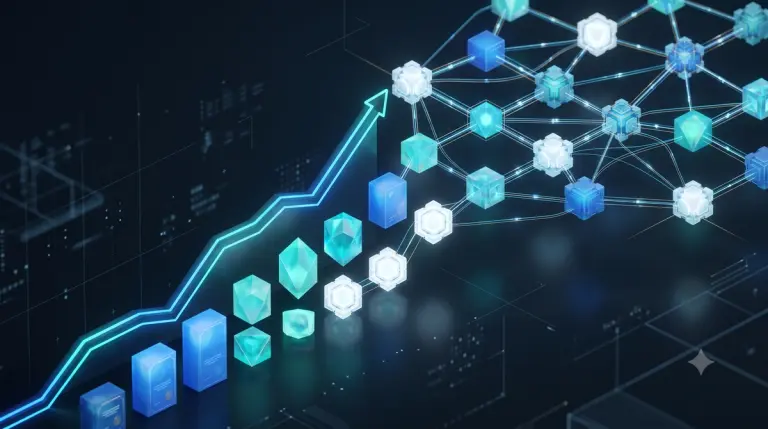
Asset Tokenization Grew 589% in a Year — and It's Still a Drop in a Potential Ocean
According to Binance Research, the market for tokenized real-world assets (RWA) grew 589% between early 2025 and June 2026. The number sounds like typical crypto hype, but underneath it is a fairly measurable process: US Treasuries, private credit, corporate bonds and fund shares are moving onto blockchains one by one — and these aren't pilot projects anymore, they're products holding billions of real dollars.
What's actually inside those billions
According to the analytics platform RWA.xyz, the "distributed" (i.e., actually transferable on-chain) value of non-stablecoin RWAs sat at roughly $26.7 billion in June 2026, against $345 billion in "represented" asset value connected to tokenized infrastructure in some form. A separate estimate from the same platform in mid-May put the figure at $31.4 billion — the gap reflects differing methodology and a steady stream of new issuances. Broken down by category, six segments have each crossed the $1 billion mark: private credit, commodities, US Treasuries, corporate bonds, non-US sovereign debt, and institutional alternative-fund shares.
Where the money actually sits
The most mature segment is tokenized US Treasuries: as of June 10, the category held about $14.79 billion across 82 products and nearly 65,700 holders, yielding around 3.35% on average. The leaders are Circle (~$2.9B), Ondo (~$2.8B), BlackRock's Securitize/BUIDL (~$2.5B), and Franklin Templeton's BENJI (~$2.5B). BUIDL is now officially the largest tokenized fund in the world.
From bonds to stocks
The next frontier isn't debt instruments — it's equities. Ondo Global Markets has launched more than 100 tokenized US stocks and ETFs, including Apple, Nvidia, Tesla, Amazon and index funds like QQQ and SPY, with plans to scale the lineup into the thousands. The infrastructure behind these products is also getting more regulated: on May 4, FINRA cleared Securitize to act as custodian for tokenized securities, settle them atomically against stablecoins, and underwrite tokenized IPOs and follow-on offerings inside its own alternative trading system.
BlackRock CEO Larry Fink framed the industry's ambition in his annual letter to investors: "Half the world's population carries a digital wallet on their phone. Imagine if that same digital wallet could also let you invest in a broad mix of companies for the long term — as easily as sending a payment." Tokenization, he argued, could "update the plumbing of the financial system."
But how big is this market, really
Against the headline percentages, scale matters. Securitize CEO Carlos Domingo describes the opportunity this way: "The $400 trillion market is any asset that is recorded on an antiquated ledger... If we go to $2 trillion in the next five or 10 years, that would be a very good outcome for everybody." In other words, even the industry's most prominent player frames the bullish case as $2 trillion over five to ten years — not overnight. Against that backdrop, today's $26–31 billion is less than 0.1% of the addressable market the industry itself talks about.
Takeaway
589% growth in a year is a real number, but it measures the acceleration of a small segment, not the maturity of a market. What separates this tokenization cycle from earlier hype waves isn't the growth rate — it's who's involved. BlackRock has grown its tokenized fund into the largest in the world, Franklin Templeton is expanding BENJI to new networks, and Securitize just won formal regulatory clearance for custody and underwriting of tokenized securities. None of that erases the trillion-dollar projections floating around the space — but it does suggest the slow, unglamorous work of building the infrastructure those trillions would eventually need is actually happening.
This article is for informational purposes only and is not investment advice. Market size estimates vary across analytics platforms — verify current data before making any financial decisions.
Comments (0)
No comments yet — be the first!
Join our community
No spam, unsubscribe in one click
Related articles
Types of cryptocurrency: 44 coins in eight sectors
Store of value, Layer 1, DeFi, payments, privacy, infrastructure, meme coins and Layer 2: what each type of cryptocurrency does and how to compare coins within it.
What is a tokenized deposit account and is it FDIC-insured?
A tokenized deposit is your bank balance on a blockchain. How it differs from a stablecoin and CBDC, which banks offer one, and when FDIC insurance applies.

What's the Best AI Tool for Your Job? A Role-Based Guide
Pick an AI tool by workflow, tech stack and compliance, in that order. Best tools by role, what free and paid tiers really give, and why certifications depend on the plan.
Most readTop 7

Silicon Valley Workers Are Wearing Noise-Cancelling Masks to Dictate AI Prompts
398AI

