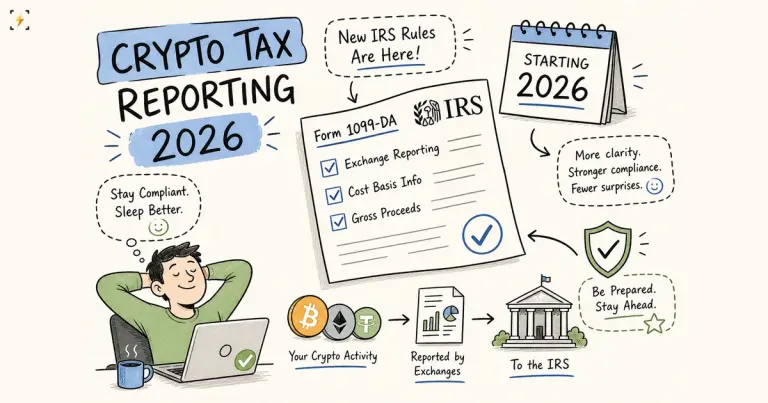
Crypto tax reporting 2026: What the IRS now requires
Starting with transactions dated January 1, 2026, brokers must now report cost basis alongside gross proceeds for covered digital assets on Form 1099-DA. Crypto tax reporting 2026 marks a significant shift in what the IRS can match automatically against your return, one of the most significant changes this year introduces to crypto tax compliance. Receiving a Form 1099-DA does not decide what you owe; the obligation to calculate gains, losses, and income accurately still belongs entirely to you as the taxpayer.
Tax reporting questions come up more than almost any other compliance topic among readers navigating U.S. crypto rules, particularly investors who held assets across multiple wallets and exchanges before 2026. This guide covers what changed, which transactions trigger reporting, which forms to use, how to reconcile broker data against your own records, what the penalties look like, and a pre-filing checklist to work through before you submit.
Key takeaways
- Cost basis is now mandatory: Brokers must report both gross proceeds and cost basis for covered digital assets on transactions dated on or after January 1, 2026.
- No minimum-dollar exemption: Every taxable disposal, regardless of size, must be reported.
- Form 1099-DA is a starting point: Treat broker-reported figures as inputs to reconcile, not as a verified statement of your tax liability.
- FIFO is the default: Specific identification, including HIFO ordering, is permitted only when lots are identified before the sale and records substantiate that identification.
- Penalties are real: According to the IRS, underreporting carries a 20% accuracy-related penalty, up to a 75% civil fraud penalty, and potential criminal exposure for willful evasion.
- Documentation wins: Missing records are the primary driver of incorrect returns and the trigger most likely to produce an IRS notice.
What actually changed with crypto tax reporting in 2026?
The rollout of Form 1099-DA happened in two phases, and understanding the distinction matters for anyone filing this year. Gross-proceeds reporting began for 2025 transactions: brokers reported what you received from a sale, but not what you originally paid. Cost-basis reporting for covered digital assets began with transactions on or after January 1, 2026. Many investors assume their broker handled both years the same way; that assumption produces errors on Form 8949.
Gross proceeds in 2025, cost basis in 2026: the key difference
For 2025 transactions, the IRS received broker data showing how much you collected from each sale, without a corresponding basis figure. For 2026, covered assets acquired and held through the same custodial broker now carry mandatory basis reporting. That changes how the IRS can cross-reference your return automatically, much the way it already matches W-2 and 1099-INT data.
What "covered" digital assets means for your holdings
A digital asset qualifies as covered only when all four conditions apply: it was acquired after December 31, 2025; it was acquired in an account where the broker provided custodial services; it was acquired in exchange for cash, a stored-value card, another digital asset, or property or services; and it remained in that custodial account continuously until the broker executed the sale. Assets transferred in from another platform, acquired before 2026, or held in noncustodial arrangements are generally noncovered, meaning basis reporting is optional or absent. When basis is missing from your 1099-DA, the broker is not necessarily wrong, the asset may simply not qualify as covered.
When broker reporting still leaves gaps
Stablecoins and certain NFTs may qualify for optional reporting methods that omit basis altogether. These assets sit in a middle category where the broker has discretion, so you should not assume a complete picture from the 1099-DA alone.
DeFi protocols and non-custodial wallets fall entirely outside broker reporting requirements. Automated market makers and lending protocols, for example, do not have a custodial relationship with users, which means no broker is collecting or submitting transaction data on your behalf. In these cases, the tax obligation remains fully with you, regardless of what any broker does or does not report.
Crypto tax reporting 2026: which transactions to report
There is no minimum-dollar exemption under current IRS rules. Investors who assume small transactions are safe are the ones most likely to accumulate mismatches when the IRS runs its automated matching process against Form 1099-DA data.
Sales, swaps, and spending crypto
Selling crypto for dollars requires you to report proceeds, basis, and the resulting gain or loss. Exchanging one token for another, including stablecoin conversions and wrapped assets, is a taxable event even though no cash changes hands. Using crypto to buy goods or services, or paying transaction fees in crypto, is also a disposal that requires proceeds, basis, and holding period documentation.
Staking, airdrops, DeFi rewards, and mining income
Staking rewards and airdrops are generally reportable as ordinary income at fair market value when you receive them. A later sale of those same assets creates a separate capital event, reported on Form 8949. DeFi liquidity pools, lending interest, and similar arrangements may create additional taxable events depending on whether ownership transferred. These structures require fact-specific analysis, and the IRS has not yet issued definitive guidance on several common DeFi arrangements, including treatment under Rev. Rul. 2023-14, which addressed staking but left open questions about more complex protocol interactions.
Transfers between your own wallets: not taxable, but still traceable
Moving crypto between wallets or exchanges you own is not itself a disposal and does not trigger a gain or loss. However, it fragments cost basis records, creates incomplete broker data, and routinely causes reconciliation problems. Document every transfer with dates, quantities, and wallet addresses before you reach filing season.
Which IRS forms apply to your situation?
One of the most common errors in digital asset reporting is using the wrong form for the wrong type of income. The activity determines the form, not the asset type itself.
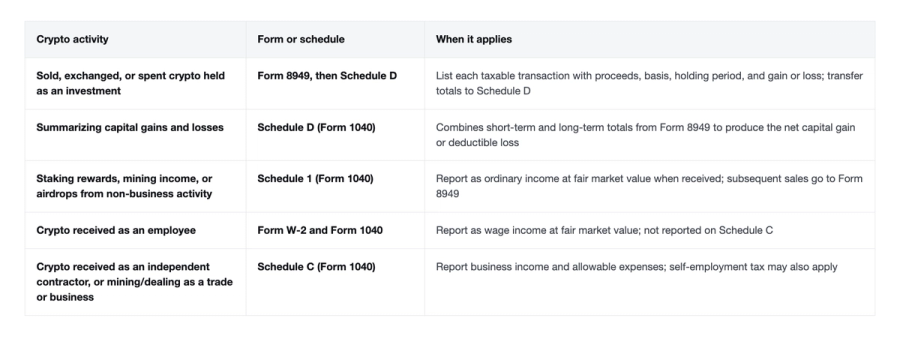
Form 8949 is the transaction-detail form; Schedule D is the summary. A taxable disposal of investment crypto generally requires both. Receiving crypto as income and later selling it can require two rounds of reporting: once when received, and again on Form 8949 when sold, using the previously reported fair market value as part of the basis.
How do you reconcile your 1099-DA with your own records?
The 1099-DA is a starting point, not a verified statement of your tax liability. Brokers may report using FIFO when you used specific identification; they may show zero basis for transferred assets; they may report wallet-to-wallet transfers as if they were sales. Treating the form as definitive without verification is one of the most expensive mistakes an investor can make this filing season.
Why the broker's cost basis numbers may not match yours
Four gaps account for most reconciliation problems: different lot-selection methods between you and your broker; missing transferred basis when assets moved from another platform; duplicate reporting from multi-exchange activity; and incorrect proceeds on assets you originally received as income. Each gap requires a documented explanation. If the broker's form is wrong, request a corrected 1099-DA and retain all supporting documentation. If your records correctly establish a different basis, report the accurate figures on Form 8949 and keep a reconciliation schedule explaining the difference.
FIFO, specific identification, and HIFO: which method applies
FIFO is the IRS default when lots cannot be adequately identified; the earliest-acquired units are treated as sold first. Specific identification, including HIFO or LIFO ordering, is permitted when you identify the particular lots before the sale and maintain records that establish the acquisition date, quantity, and basis for those specific units. This is not an after-the-fact election. It requires a standing instruction or documented lot designation made prior to the disposal; HIFO selected retroactively to minimize taxes is not valid specific identification.
What to do when basis appears as zero or is missing entirely
Zero basis on a 1099-DA usually means the broker had no acquisition data, typically because the asset was transferred in from another platform. The correct response is to trace the asset back to its original purchase records and establish the actual basis rather than accept zero. Retain complete transaction histories for at least six years, a sound practice given the IRS assessment windows. That includes:
- Exchange CSVs and wallet exports
- Transaction IDs for every disposal
- Wallet transfer logs with timestamps and addresses
- Records of staking or mining income with fair market values at the date of receipt
What are the real risks of underreporting crypto in 2026?
The risk profile changed the moment Form 1099-DA data began flowing directly to the IRS. The agency can now match broker-reported proceeds against your Schedule D and Form 8949 automatically, the same way it matches W-2 and 1099-INT data. An omitted sale is no longer simply unnoticed; it is a visible mismatch.
Penalties the IRS can assess
The penalty structure is straightforward. According to the IRS, a 20% accuracy-related penalty applies to underpayments attributable to negligence or substantial understatement, which for an individual generally means understated tax exceeding the greater of 10% of the correct tax or $5,000. A failure-to-file penalty accrues at 5% of unpaid tax per month, capped at 25%. A failure-to-pay penalty runs at 0.5% per month. The civil fraud penalty reaches 75% of the underpayment where the IRS proves intentional evasion, and it generally replaces rather than stacks on top of the accuracy-related penalty. Criminal exposure exists for fabricated records, concealed transactions, or materially false returns. The normal assessment window is three years after filing; it extends to six years when omitted income exceeds 25% of reported gross income.
What actually triggers an IRS notice or audit
The most reliable triggers are straightforward: a 1099-DA showing proceeds with no corresponding sale reported on Schedule D; large proceeds paired with unusually small reported income; repeated inconsistencies among Forms 1099-DA, Schedule D, and Form 8949; and unreported exchanges or wallets. An initial IRS contact is typically an automated underreporter notice, not a full audit. Failing to respond, or providing inconsistent answers, is what escalates the matter to an examination or, in serious cases, a criminal referral.
Pre-filing checklist for crypto tax reporting 2026
Having the documentation in hand when you sit down to file, or meet with a preparer, is what actually produces an accurate return. Work through the items below before you submit.
Records to gather now
Before any preparer or software can file accurately, collect the following:
- Every Form 1099-DA from each custodial broker
- Complete transaction histories from every exchange and DeFi platform you used
- Wallet transfer logs with timestamps and addresses
- Records of staking or mining income with fair market values at the date of receipt
- Prior-year basis documentation for assets still held
Missing records are the single biggest driver of incorrect returns. If you are reconstructing transaction history from scratch, start with the oldest records first; that is where basis errors compound most severely.
When to bring in a tax professional
Several situations clearly warrant professional involvement: multiple wallets or exchanges, any DeFi activity, staking income, materially conflicting 1099-DA figures, prior-year omissions, and anything involving potentially willful underreporting. For that last scenario specifically, consult a tax attorney before contacting the IRS or filing an amended return. The regulatory and compliance coverage at Intokened.com is designed to help you understand the rules before you sit down with a preparer, so you arrive informed and ready to make the most of that conversation.
The bottom line on crypto taxes this year
Crypto tax reporting 2026 is more structured than any prior year. Cost basis now flows directly from brokers to the IRS for covered assets, which creates both better support for accurate filing and far less tolerance for omissions. The rules are clear; the challenge, as always, is documentation.
The most effective move before filing season closes is to pull your complete transaction history, match it against every 1099-DA you receive, and resolve any discrepancies before the IRS raises them. An automated underreporter notice is manageable; an unanswered mismatch is not.
Intokened.com covers U.S. crypto regulation, AML compliance frameworks, and broader digital asset policy as the rules continue to evolve. Our explainers on the CLARITY Act, OCC stablecoin rules, and AML compliance provide useful context for investors and practitioners navigating compliance across multiple regulatory fronts. IRS guidance on DeFi protocols and non-custodial reporting remains pending, that is an area worth monitoring closely as additional rules take shape.
Frequently Asked Questions
Are very small crypto transactions exempt from reporting?
No, there is no minimum-dollar exemption under current IRS rules; every taxable disposal must be reported regardless of size. We recommend documenting and reporting even small sales, swaps, or spending to avoid mismatches when the IRS matches Form 1099-DA data to your return.
What should I do if my 1099-DA shows a zero or missing basis for assets I transferred in?
You must trace the asset back to its original purchase records and establish the actual basis rather than accept zero. We advise reconstructing prior-year basis documentation and retaining supporting records so you can report the correct basis on Form 8949 and keep a reconciliation schedule explaining any differences.

Comments (0)
No comments yet — be the first!
Join our community
No spam, unsubscribe in one click
Related articles

Safest crypto storage: cold wallets and multisig
How to keep crypto safe in cold storage: hardware wallet comparison, metal seed backups, multisig, and what the 2026 attacks changed.

What is crypto AML compliance? A guide for cryptocurrency
Discover how strengthening screening, monitoring, and risk controls can reduce exchange and VASP financial crime risk.

AI tools catalogue: 54 companies by job
Our AI catalogue holds 54 companies across 10 jobs, 187 pricing plans and a checked date on every price. Here is what is inside and how to search it.
Most readTop 7

Silicon Valley Workers Are Wearing Noise-Cancelling Masks to Dictate AI Prompts
380AI

