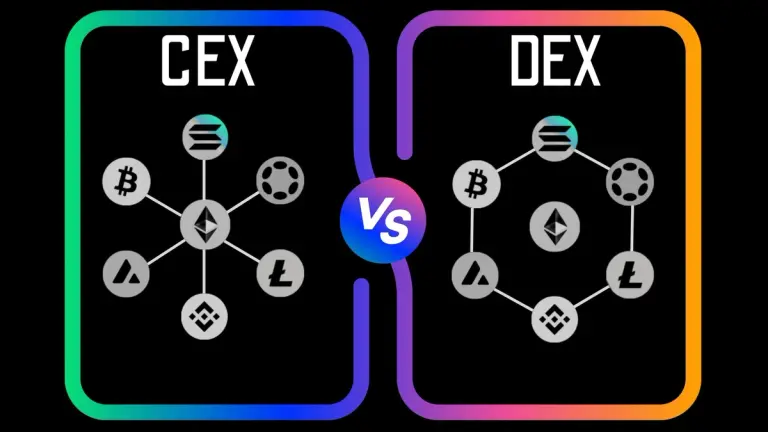
DEX vs CEX: An Exchange With a Cashier, or Without One
Open any crypto exchange for the first time and the difference is barely visible — charts everywhere, a "buy" button. But behind that identical button sit two fundamentally different answers to one question: who are you trusting with your money — a licensed company, or code that belongs to no one?
CEX: an exchange with a cashier
A centralized exchange (CEX) is the familiar model: Binance, Coinbase, or Bitbank, which SBI Holdings acquired in 2026 — we covered that deal here. You transfer money to the exchange, it holds it in its own accounts, and it shows you a balance in the app — just like a bank. Opening an account means passing KYC (identity verification with a passport or ID) — that's a regulatory requirement, not a whim of the exchange. In exchange, you get a simple interface, customer support, and a way to recover access if you forget your password — just like a bank you can actually call.
DEX: an exchange without a cashier
A decentralized exchange (DEX) — Uniswap, PancakeSwap, and similar platforms — works differently: no company ever holds your money. The trade happens directly between two wallets through a smart contract — a program that executes automatically and can't be paused or reversed by anyone. We covered what it actually means to hold your own wallet keys in a separate article, "Private Key and Seed Phrase: What Happens If You Lose Them" — on a DEX that's not an abstraction, it's the only way in: lose your seed phrase, and no company can fix it, because there's no company here to begin with. In return, no ID is required — anyone who connects a wallet gets access.
What the difference looks like in practice
Who holds the money. On a CEX, the company does, in its own accounts. On a DEX, only you do, in your own wallet.
What happens after a mistake. On a CEX, support can recover a forgotten password. On a DEX, a lost seed phrase is never recovered by anyone, ever.
Who sets the price. A CEX uses an order book: buyers and sellers post their own prices. A DEX usually relies on a liquidity pool instead: a formula calculates the price automatically, with no human on the other side of the trade.
The numbers speak for themselves
According to CoinGecko research, centralized exchanges still processed roughly 86% of spot and 90% of perpetuals trading volume in Q1 2026 — DEXs accounted for about 14% and 10% respectively. But the gap is narrowing: DEX spot share has doubled and perpetuals share has grown fivefold in just two years. Uniswap already ranks among the ten largest exchanges by cumulative volume, with roughly $73 billion in 30-day volume, outpacing CEXs like Coinbase and OKX on that measure.
A risk worth remembering
Freedom on a DEX has a flip side: if there's a flaw in the smart contract, the entire exchange can be hacked at once, not just an individual user. One of the biggest examples was Drift Protocol, Solana's largest perpetual futures exchange, drained of $285 million in about 12 minutes — we covered that case in our piece on 2026's DeFi hacks. A CEX carries its own version of that risk: if the exchange runs into solvency trouble, the money in its accounts can be lost too — just for a different reason.
The takeaway
Choosing between a CEX and a DEX means choosing between convenience with third-party trust, or full control with full responsibility. If simplicity, support, and account recovery matter most, people usually pick a CEX. If not handing your money to anyone — including the exchange itself — matters more, people pick a DEX and take full ownership of their own keys.
This article is for educational purposes only and does not constitute investment advice.

Author
JonathanEditor
I love writing about cryptocurrency, am interested in general trends, and try to reflect this in my materials.
Comments (0)
No comments yet — be the first!
The market talks all day. We write when it says something
Short, and it tells you why it came
Related articles

USDC: The dollar that Europe has allowed
$74bn in circulation and $19bn of daily turnover. Who stands behind USDC, what sits in its reserves, and why Europe let this coin stay but not USDT.

The Digital Euro: Europe's exit from non-EU payment schemes and the trust test that comes with It
Why the ECB is building its own payment rail, how it plans to keep payments private, and why trust decides whether any of it works.

How Tax Authorities Detect Undeclared Cryptocurrency Income
Why self-custody, DeFi and crypto cards do not make a person invisible, and how to restore PnL and correct tax history before an audit.
Most readTop 7

Silicon Valley Workers Are Wearing Noise-Cancelling Masks to Dictate AI Prompts
332AI

