Jensen Huang returns as Nvidia CEO after 12 days
Nvidia spent 12 days without the man who founded it. Between 11 and 23 November the world's most valuable chipmaker lost its chief executive, about $1.2 trillion of market value and any certainty about who runs it. Then the board voted unanimously to bring him back.
Nvidia CEO Jensen Huang returned to his job on 23 November 2026, less than two weeks after he resigned over an affair with an executive whom US intelligence reportedly suspected of working for China. This is the sequel to our story of how Huang built Nvidia: what he was accused of, how he left, what happened to the stock, which investigations are still open and what to expect next.
Timeline: 36 days from the first report to the hearings
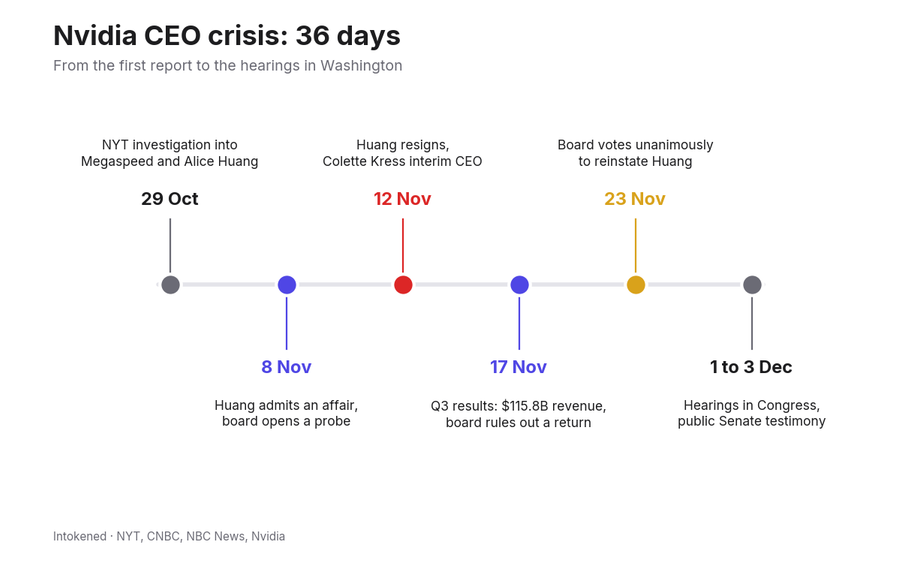
The story started with a chip buyer in Singapore. On 29 October The New York Times published an investigation into Megaspeed International, a Nvidia customer that had bought more than $4.8 billion of its chips in two years, and into Alice Huang, an executive there who is no relation to the CEO.
A week later the pressure moved to Washington. On 5 November three House committee chairs asked Huang for a closed-door briefing, and on 6 November the Financial Times reported that the US government believed the two had a romantic relationship.
On 8 November Huang admitted an affair in a memo to staff, and the board opened an independent investigation the same day. Four days later he was gone. We traced the early reports day by day in our scandal timeline.
What Huang was accused of
Three separate claims ran together. Keep them apart, because Huang confirmed only one of them himself.
- The affair. Huang admitted it on 8 November without naming the woman. The NYT and the Financial Times identified her as Alice Huang.
- The spy suspicion. The NYT reported that US intelligence considered Alice Huang an asset of China's Ministry of State Security, and on 22 November that she was in contact with one of its officers during at least part of the relationship. Beijing denies it, and no US agency has confirmed it on the record.
- A second relationship. The NYT reported that Huang also had a relationship with Kimberly Powell, Nvidia's vice president of healthcare and one of his direct reports. Nvidia has not confirmed it.
“I was unfaithful to my wife. My actions hurt her and our children. There is no excuse for what I did. I am deeply sorry.”
— Jensen Huang, memo to Nvidia staff, 8 November 2026
Quote source: NBC News
Huang has not been charged with anything. Attorney General Todd Blanche told President Trump that the Justice Department had no evidence of wrongdoing by Huang or Nvidia, NBC News reported.
Behind the personal story sits an export case. US investigators have examined Megaspeed over possible smuggling of Nvidia chips to China, and the NYT reports that a criminal case is still open. Bloomberg reported that Nvidia's general counsel Tim Teter contacted the Commerce Department during that probe, as we covered in our Megaspeed story. Megaspeed and Nvidia deny wrongdoing. Megaspeed says inspections by the US Bureau of Industry and Security, Malaysian authorities and Nvidia itself found no evidence of any violations.
The export questions are older than the affair. In October 2025 Senator Tom Cotton asked Commerce Secretary Howard Lutnick to investigate Megaspeed, and in December 2025 Bloomberg reported a US probe into its ownership and possible chip smuggling. In spring 2026, the NYT reported, a memo reached policymakers identifying Alice Huang as recruited by Chinese intelligence.
How Nvidia's CEO left
The board accepted Huang's resignation on 11 November and announced it the next morning. He left both the chief executive role and the board with immediate effect, after 33 years as the only CEO Nvidia had ever had.
Chief financial officer Colette Kress became interim CEO and kept her finance job. The board named its first chair, Harvey C. Jones, a former Synopsys chief, and hired a search firm. President Trump proposed Apple's Tim Cook as a successor on Truth Social, and NBC News reported that the board approached Arm CEO Rene Haas, who said he would stay at Arm.
On 17 November Nvidia reported its third quarter without Huang. Revenue reached $115.8 billion, up 103% from a year earlier, and the company guided to about $130 billion for the next quarter. Data centre revenue, the business that sells AI chips to cloud providers and labs, grew 110% to $107.6 billion.
“Our momentum is real. NVIDIA is an exceptional technology leader, powered by the relentless innovation of our people.”
— Colette Kress, interim CEO and CFO, third-quarter results, 17 November 2026
Quote source: Nvidia
The same week, Jones said the board had unanimously accepted the resignation and did not intend to reinstate Huang as CEO. The board reversed that decision six days later.
What happened to Nvidia stock
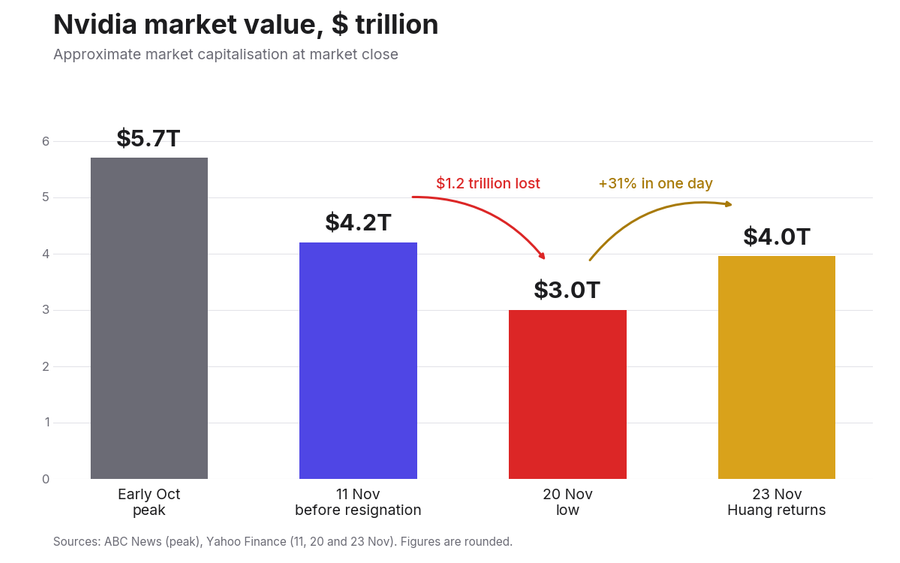
Investors reacted before the board did. Nvidia peaked at about $5.7 trillion in early October, ABC News reported. At the close on 11 November, the last session before the resignation, it was worth about $4.2 trillion, and on 20 November about $3.0 trillion, according to Yahoo Finance.
That is about $1.2 trillion lost in seven trading sessions. CNBC counted that the stock shed nearly 33% from the day Huang admitted the affair. On the morning the resignation was announced, the shares fell about 10% before the open to around $155.
The slide began before the resignation. A chip selloff on 6 November cost Nvidia about $450 billion in a day, and on 9 November, the first session after the memo, the stock closed 4.27% lower.
Some traders made money on the fall. One unnamed buyer of put options turned about $8.3 million into roughly $196 million on paper, as we described in our story on that put trade. On the other side, Hyperliquid's engine closed a long position of about 9,960 Nvidia perpetual contracts, and its owner lost about $1.54 million in the liquidation.
Jobs took 12 years, Altman less than a week
Founders have come back before, but rarely this fast. Apple pushed Steve Jobs out in 1985, and he returned only in 1997, after Apple bought his company NeXT. OpenAI's board fired Sam Altman on 17 November 2023, and he was back less than a week later, after most of the staff threatened to leave.
Huang's case sits closer to Altman's. In both stories the board acted first and the pressure from outside reversed it within days. At OpenAI the pressure came from employees and Microsoft. At Nvidia it came from shareholders, prominent investors and the White House.
Investigations that are still open
Huang is back in charge, and four investigations continue:
- Board review. A committee of independent directors and the law firm Wachtell, Lipton, Rosen & Katz continue the internal investigation. No findings have been published.
- SEC. The Wall Street Journal and Reuters reported an SEC inquiry, which the WSJ says focuses on accounting practices. The SEC declined to comment.
- California. Attorney General Rob Bonta's office confirmed on 23 November that it will keep investigating Nvidia.
- Congress. Huang is due at a closed-door interview with three House committees on 1 December and general counsel Tim Teter on 2 December. On 3 December Huang is set to testify in public before the Senate Banking Committee as the only witness.
How the board brought Huang back
The U-turn took one weekend. According to CNBC's sources, senior officials told the board late the previous week that no national security laws had been broken. Huang and the directors spoke on Saturday for the first time since he left, and a second meeting on Sunday settled his return. The falling share price sped up the talks, CNBC reported.
Pressure came from several sides. Elon Musk and investors Gavin Baker and Brad Gerstner lobbied for Huang, and a Stand with Jensen petition gathered more than 100,000 signatures, Yahoo Finance reported. Trump told CNBC he had spoken with the board directly and indirectly and that Huang did nothing wrong.
On Monday, 23 November, the board voted unanimously to reinstate Huang as president, CEO and director. Its statement says the directors received input from senior levels of the US government and are confident his return poses no national security risk. Kress went back to being CFO.
“I take this responsibility with the greatest humility and renewed commitment.”
— Jensen Huang, Nvidia statement on his reinstatement, 23 November 2026
Quote source: Nvidia
The stock closed up about 31%, its best day since 2003, and added roughly $950 billion in market value. On Polymarket, the odds of Huang's return jumped from about 3% to about 99% within minutes of the announcement.
Critics questioned the decision. Senator John Cornyn asked on X what the board based its national security verdict on. Yale's Jeffrey Sonnenfeld told NBC News the episode looks like a serious erosion of capitalism.
The conditions of Huang's return
Huang returns to the same office with more oversight around it. The board's statement sets out three changes:
- A new National Security and Export Control Committee made up only of independent directors, with its own national security counsel.
- A search for a chief compliance officer who will report to the board's nominating and corporate governance committee.
- Harvey Jones stays as board chair, a post Nvidia created only this month.
The independent investigation will also proceed to its conclusion, the board says, so its findings can still reach Huang after his return.
What to expect from Nvidia next
The first test comes in the week of 1 December. Huang's testimony before the Senate on 3 December will be the first time he answers public questions about Alice Huang and Megaspeed.
The second test is the business. Nvidia guided fourth-quarter revenue to about $130 billion, plus or minus 3%, and assumes no data centre compute revenue from China. That quarter includes an extra week, so compare it with the previous quarter as well as with last year. Nvidia also expects its gross margin to slip to between 71% and 72%, from 74.8% in the third quarter.
Third, the market still has doubts. The shares fell more than 4% before the open on 24 November, the day after the rally. Yahoo Finance cited an MIT Sloan study of 167 returning S&P 500 chief executives between 1992 and 2017: their stocks did about 10% worse per year than those under first-time CEOs.
Analysts mostly read the return as a business decision. Dan Ives of Yorkville Ives told CBS News the board had no choice, and Adam Crisafulli of Vital Knowledge said Huang's flat corporate structure made him hard to replace. Gil Luria of D.A. Davidson credited pressure from the White House.
Maks watches bitcoin first, because it sets the trend for the rest of the crypto market. This month showed that one person's private life can move a $4 trillion stock by a third in two weeks. If you hold shares or tokens tied to the AI trade, mark 1 and 3 December in your calendar: the hearings are the next event that can move Nvidia.
This article is for information only and is not investment advice. Reports about Alice Huang rely on unnamed sources, and no charges have been filed against Huang or Nvidia.

Author
Maks RybalkoReviewer
For the past four to five years, I've been actively interested in the cryptocurrency market, using a variety of tools: trading bots, trading, and long-term investing. I share my personal observations in my articles.
Comments (0)
No comments yet — be the first!
Join our community
No spam, unsubscribe in one click
Related articles

Crypto Exchange Security in 2026: What the Binance Hack Reveals, How AI Is Changing Security, and Why Protection Doesn't End With an Audit
HackenProof's CEO and CTO on the Binance hack, why exchange security doesn't end with an audit, how AI changes bug bounties and how users can protect assets.
Types of cryptocurrency: 44 coins in eight sectors
Store of value, Layer 1, DeFi, payments, privacy, infrastructure, meme coins and Layer 2: what each type of cryptocurrency does and how to compare coins within it.

What is a tokenized deposit account and is it FDIC-insured?
A tokenized deposit is your bank balance on a blockchain. How it differs from a stablecoin and CBDC, which banks offer one, and when FDIC insurance applies.
Most readTop 7

Silicon Valley Workers Are Wearing Noise-Cancelling Masks to Dictate AI Prompts
403AI

