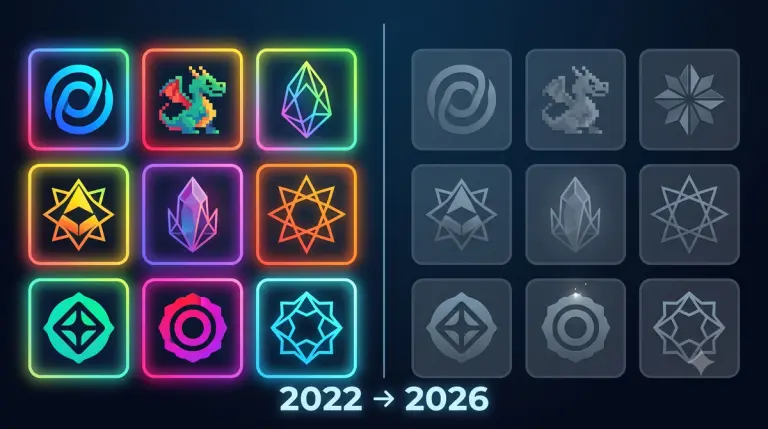
The End of the NFT Era: How the Market Fell 98% From Its Peak and What's Left in 2026
On February 23, 2026, Nifty Gateway shut down — one of the earliest major NFT marketplaces, which at its peak had facilitated over $300 million in sales. Its closure isn't an isolated event; it's a symbol of what happened to the entire NFT market over the past four years, from the frenzy of 2021–2022 to a market that today survives almost entirely on a handful of collections.
The boom: 2021–2022
At its peak in early 2022, monthly Ethereum NFT trading volume hit roughly $6 billion. Those were the years of Bored Ape Yacht Club, CryptoPunks, and dozens of platforms promising to become the next Christie's for digital art — it was in 2020 that Nifty Gateway itself launched.
The crash: what's left of the volume
By 2026, the picture looks different. Monthly Ethereum NFT volume has stabilized at around $720 million — 50% above the 2024 trough of $480 million, but still 79% below the 2022 highs. On particularly weak days, volume has dropped as low as $106 million — against a monthly figure that hit $6 billion back in early 2022. Total NFT trading volume for all of 2025 is estimated at around $5.5 billion — versus tens of billions in the peak years, according to CleanSky's analysis.
The market has gone "K-shaped"
The decline isn't evenly distributed. Three blue-chip collections — CryptoPunks, Bored Ape Yacht Club and Azuki — now capture about 70% of all PFP trading volume and hold floor prices above $10,000, while the median collection has lost roughly 79% of its value, and about 96% of all minted collections show no meaningful trading activity at all. Among marketplaces, Blur holds around 38% of Ethereum NFT volume, remaining the venue of choice for professional traders, The Block notes. OpenSea rolled out a redesigned architecture called OS2, cutting fees from 2.5% to 0.5% and eliminating swap fees entirely — but more than 90% of the platform's volume today comes not from traditional NFTs but from fungible tokens: even the largest marketplace is effectively turning away from its original product.
Legacy platforms shutting down
Against that backdrop, Nifty Gateway's closure looks less like an isolated failure and more like a pattern. Starting January 23, the platform entered withdrawal-only mode, and on February 23 it shut down entirely, with users' tokens moved over to Gemini Wallet, CoinDesk reports. In April, the same fate hit Foundation, a notable digital-art marketplace, after its planned acquisition by Blackdove fell through.
In its official statement, Gemini explained the decision this way: "This decision will allow Gemini to sharpen its focus and execute on the vision of building a one-stop super app for customers" — in other words, Nifty Gateway's closure isn't framed as a product failure, but as a consequence of its parent company's shifting priorities.
Takeaway
The NFT market hasn't died entirely, but it has shrunk and stratified dramatically: instead of a broad market of thousands of active collections, what's left is a narrow premium tier of a few blue chips — alongside a huge stack of infrastructure (exchanges, marketplaces, specialized platforms) that was built for a market worth tens of billions and is no longer needed at that scale. The closures of Nifty Gateway and Foundation aren't symptoms of isolated management mistakes — they're a rational response to a market that became far smaller than the infrastructure originally built to serve it.
This article is for informational purposes only and is not investment advice. The NFT market remains highly volatile and illiquid outside a narrow set of collections — assess risk independently.
Comments (0)
No comments yet — be the first!
The market talks all day. We write when it says something
Short, and it tells you why it came
Related articles

The Digital Euro: Europe's exit from non-EU payment schemes and the trust test that comes with It
Why the ECB is building its own payment rail, how it plans to keep payments private, and why trust decides whether any of it works.

How Tax Authorities Detect Undeclared Cryptocurrency Income
Why self-custody, DeFi and crypto cards do not make a person invisible, and how to restore PnL and correct tax history before an audit.

AI stops where checking gets expensive
Five deployments from one week, all with published numbers. The line between the successes and the reversals is not capability. It is how fast and how cheaply anyone can establish that the machine was wrong.
Most readTop 7

Silicon Valley Workers Are Wearing Noise-Cancelling Masks to Dictate AI Prompts
330AI

