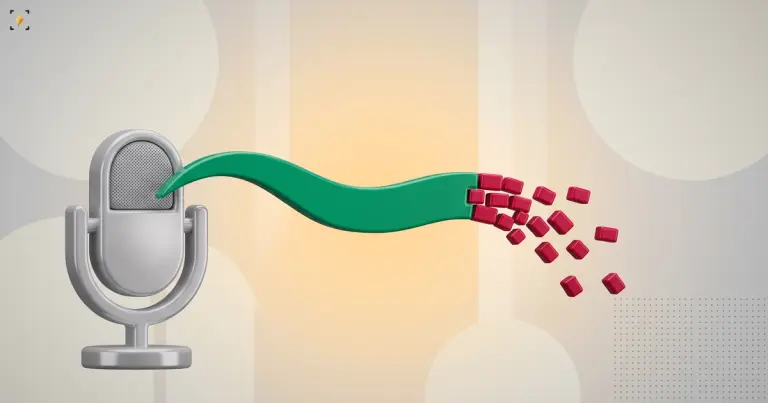
AI dictation: 95% accuracy advertised, 8-12% word error measured
Every dictation service sells a single number and it is always a big one: 85% accurate, 95% accurate, up to 99% on clean audio. Transcription accuracy is a measured quantity, and those numbers are not invented. They are measured on the kind of audio that produces them, and almost nobody dictates into that kind of audio. Here are the figures side by side.
The three that matter:
- On the LibriSpeech benchmark, clean read speech: 2.7% word error rate.
- On real-world English: 8% to 12%, which is three to 4.4 times the benchmark.
- Advertised by the services themselves: 85% to 99% accurate, meaning 1% to 15% error.
LibriSpeech is read audiobook speech, recorded cleanly, one speaker at a time. A meeting is not that, and neither is a voice note walked through a street. The field measurements for the same model land at 8% to 12%, so the working error rate is three to four and a half times the benchmark that gets quoted in marketing. Both numbers are honest. Only one describes your recording.
Translate it into the thing you will actually hold. Fifteen minutes of speech at a normal 150 words per minute is about 2,250 words. At the advertised 95% accuracy that is 113 wrong words. At the measured real-world range it is 180 to 270. On a single dictated page of 1,000 words, expect 80 to 120 words to need fixing rather than the 50 the packaging implies.
Hallucination is a different failure
“Improvements specifically developed to suppress hallucinations and make the transcription of medical terms more accurate than any off-the-shelf speech-to-text engine on the market.”
— Nabla, From the company's description of its medical model
Nabla, describing the changes it made to Whisper for medical use
A wrong word and an invented sentence are different failures, and only the first one is counted by a word error rate. An AI hallucination is text the model produced that nobody said. A peer-reviewed study found hallucinated phrases in about 1% of samples, and 38% of those carried explicit harm: invented violence, false attributions, medications that were never prescribed. Reported rates run from 1% to 80% depending on conditions, and the conditions that trigger them are silences longer than 30 seconds at segment boundaries, frequent pauses and disfluencies. That is a description of an ordinary conversation.
This is why a medical vendor advertises hallucination suppression as a feature rather than assuming it. If the failure mode were rare or obvious, it would not need a product line.
What it costs to check
The cost of checking is the part with the cleanest arithmetic. Rev charges $0.07 a minute for machine transcription and $0.79 a minute for human-edited, which is 11.3 times more. For a one-hour recording that is $4.20 against $47.40. The $43.20 difference is precisely what you pay to avoid reading 180 to 270 words yourself. Otter gives 300 free minutes a month and charges $8.33 monthly on an annual plan; Fireflies runs $10, $19 and $39 per user per month by tier. At those prices the machine transcript is nearly free and the verification is the expensive part, which is the opposite of how the category is sold.
Use it where a wrong word is cheap: your own notes, a draft, a searchable archive you will read anyway. Check it where a wrong word is not. Police forces are already drafting reports from body-cam audio with the same class of model, and we measured what happens when the accuracy metric arrives later than the purchase order. The consumer version of the same problem is a recorder that produces AI summaries longer than the notes they describe. Ask one question before you trust any transcript: if this sentence were wrong, would anything tell me?
Informational material, not investment advice. Error rates are published benchmark and field figures for Whisper Large-v3 and vary by language, audio quality and speaker; prices are list prices as of 22 September 2026. The arithmetic applying them is ours.

Comments (0)
No comments yet — be the first!
The market talks all day. We write when it says something
Short, and it tells you why it came
Related news

Most readTop 7

Silicon Valley Workers Are Wearing Noise-Cancelling Masks to Dictate AI Prompts
307AI

