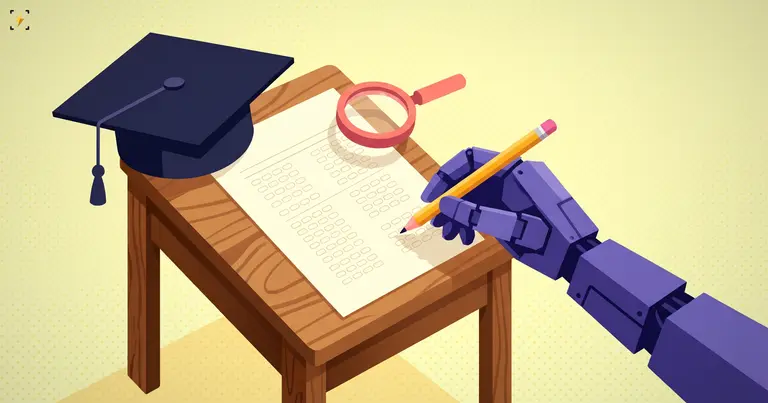
AI makes coursework close to impossible to assess, England’s regulator says
England’s higher education regulator says AI tools can finish much of the unsupervised coursework that universities set, and that students can often use AI in ways that staff cannot catch with confidence. The Office for Students (OfS) and Advance HE published the research on 11 November and asked universities for far greater use of AI-free assessment.
The study draws on 244 staff and 91 students from at least 127 universities, the BBC reported. Lecturers told the researchers that assessing coursework had become close to impossible, The Guardian wrote.
Coursework done in minutes
In one case students said classmates finished an unsupervised assessment with an LLM in a few minutes and got grades similar to peers who worked alone. Some staff receive many near-identical assignments and no longer consider their institution’s assessments fit for purpose. The report adds that AI detection tools miss AI use often enough that staff cannot rely on them, a problem we saw with the OpenAI text watermark.
Staff also describe a polarised atmosphere between students who use AI and “conscientious objectors” who avoid it. A HEPI survey of 1,054 UK undergraduates in March found that 94% use generative AI for assessed work, up from 88% in 2025.
What the regulator wants
The OfS names closed-book exams, presentations, practical assessments and performances as the most valid measures of what students know. Universities must make their assessments measure knowledge and skills validly and reliably, and in many cases that means secure, AI-free assessment.
If a university falls short, the regulator can impose specific conditions of registration, fine it, or suspend its access to student support and grant funding. Under proposals now in consultation, universities that fail quality standards could also lose the right to charge higher tuition fees or face caps on student numbers.
Josh Fleming, director of strategy and delivery at the OfS, praised “fantastic” examples of universities using AI well. He also told the BBC that AI “presents a generational risk to the system as it stands”.
“Senior leaders are well placed to help by setting a shared vision for AI.”
— Kathryn Harrison-Graves, deputy chief executive of Advance HE, OfS and Advance HE press release, 11 November 2026
Quote source: OfS press release, 11 November 2026.
How universities answer
Universities UK, which represents more than 140 institutions, said its members are making significant progress and have moved to more in-person exams, vivas, presentations and process-based assessment. Lewis Wilson of the National Union of Students called for scrapping outdated methods and designing assessments together with students.
Advance HE will launch an AI-focused Change Academy programme for its members in early 2027. Remote exams remain widespread: a Swansea University study last year found that 93 UK universities still run online exams in some form, a format that spread during Covid.
If you study in England, expect more exams in the room and oral defences of written work. Read your course’s AI policy before the next deadline, since the OfS found that students struggle to understand those rules. Fewer graduates go straight into the jobs their degree once led to: only 28% of UK computer science graduates went into coding jobs.
The findings describe what staff and students told the researchers, and the sanctions on tuition fees and student numbers are still proposals under consultation. This is a news report about education policy, not advice on how to use AI in your studies.

Author
MaksTrading man
I've been interested in the cryptocurrency market for a long time, am a trader, and write articles and news about my experience and crypto in simple terms.
Comments (0)
No comments yet — be the first!
Join our community
No spam, unsubscribe in one click
Related news


Most readTop 7

Silicon Valley Workers Are Wearing Noise-Cancelling Masks to Dictate AI Prompts
396AI

