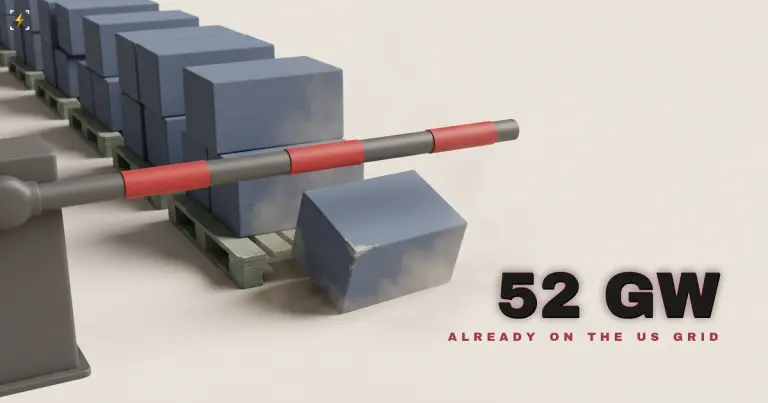
The Chinese battery ban lands on a US fleet that grew from 9 to 52 GW
In late August the Trump administration declared a national emergency and banned foreign-made bulk-power equipment that poses a security risk from American grids, naming battery storage systems, inverters and transformers. MIT Technology Review asks whether the US battery market can untangle from China at all. Both halves of that question have numbers attached.
Start with what is already in the ground. The Energy Information Administration counted this in August:
- 43.6 GW of battery storage operating at the end of 2025.
- 8.3 GW added in the first half of 2026, taking the fleet to almost 52 GW.
- 54 GW more planned by the end of 2028, of which 14 GW is due this half-year.
Run the agency's own 70% average annual growth back from 43.6 GW and the fleet stood under 9 GW at the end of 2022. It has multiplied roughly six times in three and a half years, and it did that on cheap Chinese cells.
What the order actually covers
The order reaches existing plants as well as new ones. Isshu Kikuma of BloombergNEF points out what that would mean if anybody enforced it literally: most installed battery storage in the country uses Chinese cells, so the letter of the order would strip most storage off the grid. Nobody expects that.
The live number is the 14 GW planned for this half-year. The Department of Energy owes detailed guidance by the end of December, which puts the rules and the installations in the same quarter. Projects that have to switch cells will pay more for them, whether the replacements are American or Korean, and Kikuma's worst case is cancellation.
The case on the other side
The case for the ban does not rest on price. One country supplies most of the cells in equipment the grid cannot run without, and that is the risk Washington is pricing. This is the third tool tried: the 2022 Inflation Reduction Act tied tax credits to where minerals were mined and cells assembled, the 2025 rewrite requires 55% of material cost to come from outside China and other restricted countries starting this year, and import duties went from 7.5% to 25% in January, a 3.3-fold rise.
“An outright ban was a bit of a surprise, and it does create a bit of concern for domestic players in the US.”
— Shan Tomouk, MIT Technology Review, 10 September 2026
Shan Tomouk, Benchmark Mineral Intelligence, in MIT Technology Review, 10 September 2026
Domestic supply is arriving on a slower clock. New plants from LG Energy Solution, Samsung SDI, Ford and SK On come online or ramp up next year, helped by a slowing electric-vehicle market that frees lines built for car cells. The country could hold enough nameplate capacity by about 2030, though factories that never reach full output mean supply catches demand later in the 2030s. American cells stay dearer than Chinese ones throughout.
Why this sits on our beat
This is our beat because of what fills the other side of the meter. AI data centres and bitcoin miners are the fastest-growing new load on the same grid, and storage is what absorbs them without new gas plants. A rule that slows 14 GW of batteries lands on the same substations that AI capacity is queuing for.
We made the same argument about drone tariffs two weeks ago, and the arithmetic is the same. A duty or a ban changes who may sell, and it does not by itself create a factory, a trained line or a cost curve.
Watch two dates rather than the rhetoric. The Department of Energy guidance is due by the end of December, and the 14 GW is due in the same window. If the guidance slips and the projects do not, developers will have made the choice for Washington.
This piece is informational, not a recommendation to buy, sell, or hold any asset.

Author
MaksTrading man
I've been interested in the cryptocurrency market for a long time, am a trader, and write articles and news about my experience and crypto in simple terms.
Comments (0)
No comments yet — be the first!
Join our community
No spam, unsubscribe in one click
Related news
Most readTop 7

Silicon Valley Workers Are Wearing Noise-Cancelling Masks to Dictate AI Prompts
380AI

