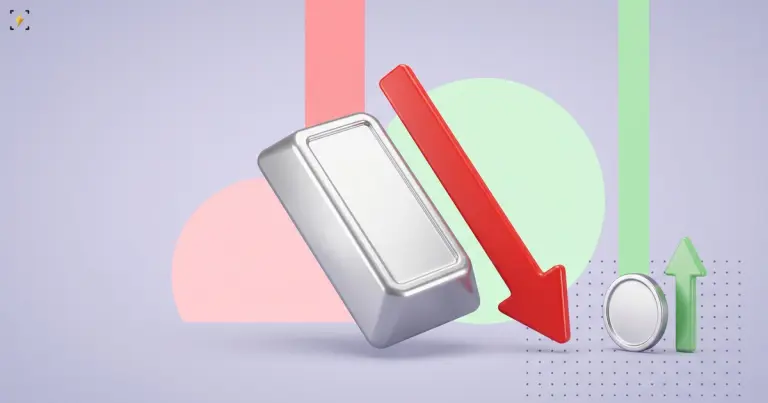
Tokenized silver: the lease fee needs 5.8 years to cover silver's drop
Theo, a New York onchain finance platform, launched a yield-bearing tokenized silver product backed by more than $40 million of active leases, CoinDesk reports. The token, thSLVR, keeps the holder's exposure to the metal and passes on the fee that refiners and mints pay to borrow it.
“Refiners, mints and industrial manufacturers routinely borrow silver to meet production needs without assuming price risk. The income has traditionally accrued to bullion banks and dealers rather than investors holding silver through exchange-traded funds.”
— CoinDesk, Report of 16 September 2026
CoinDesk, describing the mechanism the product redirects
Tokenized silver: what is actually new
The tokenization is not the new part. Kinesis has run a silver token for years and it carries $239 million today, against $2.70 billion for Tether Gold and $1.89 billion for Pax Gold. Theo's $40 million is 0.8% of that $5.16 billion tokenized metals market and 16.7% the size of the silver token already on it. What is new is where the lease fee goes.
That fee is the whole proposition, so it is worth knowing what it normally is. In years of ample supply a one-month silver lease runs about 0.3% to 0.5% annualised. In January this year it went above 8%, and by early February it was 6.3%. The rate that makes this product interesting is sixteen to twenty-seven times the ordinary one, and it exists because London vaults ran short.
Now hold that against the price of the thing being lent:
- Silver peaked at $121.30 on 29 January and trades at $64.78, which is 53% of the peak.
- The year's low was $55.90 on 16 July, giving a range of 106% between low and high.
- Thirty-day realised volatility is 36.0% annualised, against 39.9% for bitcoin and 23.3% for gold.
Those two facts belong to the same event. Silver's lease rate spiked in January because metal was scarce, and the price spiked with it, reaching $121.30 on 29 January. Everything since has been the unwind. A holder who took the token at the top would have collected the richest lease fee available and watched the collateral fall 46.6%.
Put numbers on the trade-off. At 8% a year, the lease income needs 5.8 years to offset a 46.6% fall in the metal. At the ordinary 0.4%, it needs 116 years. Over a single month an 8% annual rate pays 0.67%, while silver has been moving tens of percent inside a month all year. The yield is real income and it is not a hedge, and those are different claims that marketing tends to blur.
What decides whether it works
The product is still a sensible piece of plumbing. The lease market exists, the fee exists, and it has been collected by bullion banks rather than by the people whose metal sits in the vault. Routing it to the holder is the same argument made for tokenised deposits and for putting corporate bonds on a ledger: the asset does not change, the distribution of the income does.
Two things decide whether it works. The first is whether the lease rate normalises, because at 0.4% the yield stops covering anything at all. The second is custody and counterparty risk, which the announcement does not spell out: borrowers return an equivalent amount of metal later, and somebody carries the risk that a refiner does not. Theo says the product will also support its thUSD stablecoin, which is worth watching, because collateral that swings like this is not obviously what a dollar token wants underneath it.
Informational material, not investment advice. Metal prices and volatility were measured at 13:00 UTC on 16 September 2026.

Comments (0)
No comments yet — be the first!
The market talks all day. We write when it says something
Short, and it tells you why it came
Related news
Most readTop 7

Silicon Valley Workers Are Wearing Noise-Cancelling Masks to Dictate AI Prompts
296AI

