USDT transfer mistakes: wrong network, poisoned addresses and frozen funds
No one can reverse a confirmed USDT transfer. You can still fix some USDT transfer mistakes, and the outcome depends on whether anybody controls the address that received the money.
Wrong network
You sent USDT on BNB Smart Chain to your own self-custody wallet instead of Ethereum. The money is safe. Networks with 0x addresses use the same key, so add BNB Smart Chain in the wallet and the tokens appear. Keep coin of that network to pay the fee if you want to move them back.
An exchange is a harder case. If you deposited on a network the exchange does not accept for USDT, only the exchange can return the money. Many exchanges have a recovery form, charge a fee for it and take days or weeks. Some refuse. Write to support right away and attach the transaction hash.
The money is gone if you sent it to the USDT token contract itself or to an address that nobody controls. The same goes for a deposit address of a service that has closed.
Poisoned addresses
Attackers watch for large transfers. Then they send you a zero or tiny transfer from an address with the same first and last characters as one you used. The next time you copy an address from your history, you copy theirs. We covered this trick and other wallet threats on 15 November.
- do not copy addresses from your transaction history
- keep checked addresses in the address book
- compare the middle of the address, not only its ends
- ignore unexpected small incoming transfers
Fake tokens work the same way. Anyone can create a token named USDT and send it to you. Before you accept a payment, open the token in a block explorer and compare its contract with the one Tether lists on its website for that network. A fake token has no value and cannot be sold.
Frozen funds
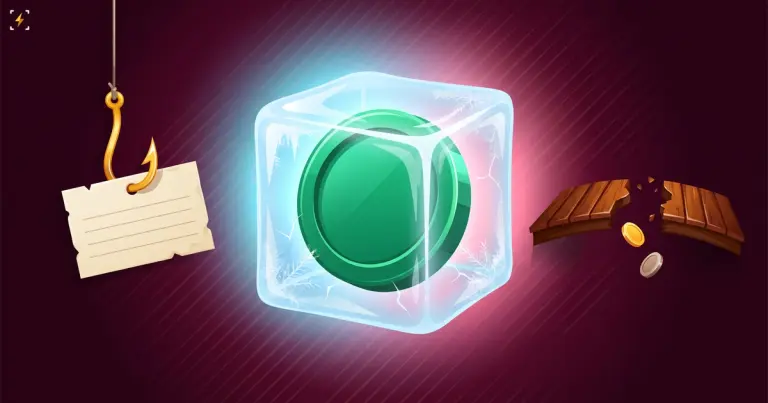
Tether can freeze USDT at any address, and it does so at the request of law enforcement. Over its history Tether's freezes have reached $4.9 billion. A frozen address can still receive tokens, but it cannot send them anywhere.
Exchanges run AML checks on incoming deposits. If USDT comes to you from an address linked to fraud or sanctions, the exchange may hold the deposit and ask where the money came from. This happens most often with P2P deals with strangers.
- take P2P payments only from exchange accounts or wallets you know
- keep the transaction hash, the chat and the order details
Restrictions in Europe
Tether has no licence under MiCA, the EU crypto rules, and regulated exchanges in the EEA have limited USDT for European users. Coinbase gave such users three days in October. Before you send USDT to an exchange in the EU, check that it still accepts the deposit.
If something has gone wrong
- do not send the money again to test it
- find the transaction hash and check the status in a block explorer
- contact support only through the official app or website
- never share your seed phrase, whoever asks
After a failed transfer people offering paid recovery services often get in touch. A real exchange support team never asks for a seed phrase or an advance payment, so treat any such request as a scam.
The basic steps of a correct transfer are in our guide to sending USDT. Check the network, the address and the fee before each payment, and you avoid most of the mistakes above.
This guide is for information only. Recovery rules differ between exchanges and wallets, so check your provider's terms before you act.

Comments (0)
No comments yet — be the first!
Join our community
No spam, unsubscribe in one click
Related news
stUSDT winds down, and JustLend starts removing its wstUSDT market

Swissquote offers Lombard loans in Swiss francs at 0% for six months
Binance Research names ETF outflows and miner sales behind the bitcoin drop
Most readTop 7

Silicon Valley Workers Are Wearing Noise-Cancelling Masks to Dictate AI Prompts
398AI

