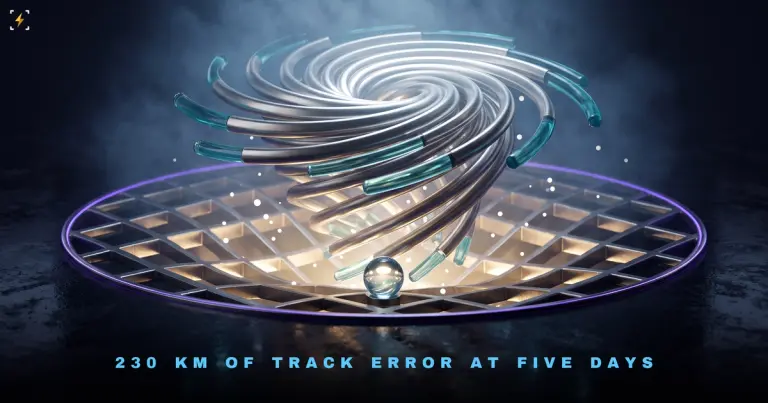
The better cyclone forecast runs on a grid a hundred times coarser
Google's WeatherNext model forecasts cyclone tracks better than the systems meteorologists have relied on, according to a paper in Nature that The Guardian wrote up. The headline gain is a three-day forecast as accurate as a two-day one used to be.
Average track error five days out, from the DeepMind write-up:
- WeatherNext Cyclones: 230 km.
- Google's own GenCast: 335 km.
- The European Centre's ENS ensemble: 370 km.
That is 140 km better than ENS, a 38% reduction, and 105 km better than GenCast. In time rather than distance it comes to about 30 hours of extra lead against ENS and 24 against GenCast.
The winning model is the coarse one
WeatherNext Cyclones works from data on a 28 by 28 kilometre grid, which DeepMind describes as a hundred times coarser than the traditional models it beats. A hundred times coarser counts by area, so the cells it beats measure under three kilometres on a side. The stripped-down version runs at 111 by 111 kilometres, a cell nearly sixteen times larger again, and still performs.
Physics models earn accuracy by resolving smaller and smaller pieces of atmosphere, and that is why they need supercomputers. This one learned the shape of storms from past storms instead, so a coarse grid costs it much less than it would cost a solver.
Six weeks for one day
Lewis Fry Richardson, a Met Office mathematician, set out numerical weather prediction more than a century ago in a book called Weather Prediction By Numerical Process. Done by hand, a single daily forecast took him more than six weeks.
By the time Richardson finished, the weather he had computed was six weeks gone. Forecasters have spent the century since chasing that gap, and Google's model now runs three days ahead of it.
A claim you can actually check
The Guardian adds a caveat worth repeating. These systems do not beat physics models across the board. They match them for less money and less time, and on cyclone tracks they now come out ahead.
“AI-based systems now rival conventional models for forecasting on several scales. And while they are not necessarily superior, they can produce comparable forecasts faster and at lower cost.”
— The Guardian, The Guardian, 10 September 2026
The Guardian, 10 September 2026
Set this beside the AI claims we have measured this week. In drug discovery the AI advantage disappears at phase 2, and the chief executive of Nvidia declared that AGI has arrived on the evidence of a chip count.
This claim has edges: a named unit, named competitors, a paper in Nature with the code and model weights released in August. Anyone with the data can check whether 230 beats 370.
Evacuations, port closures and grid shutdowns all run on lead time. An extra day gives the people running them room to move buses and fuel before the wind arrives.
Nothing here should be taken as financial advice; treat it as information to consider.

Author
MaksTrading man
I've been interested in the cryptocurrency market for a long time, am a trader, and write articles and news about my experience and crypto in simple terms.
Comments (0)
No comments yet — be the first!
Join our community
No spam, unsubscribe in one click
Related news



Most readTop 7

Silicon Valley Workers Are Wearing Noise-Cancelling Masks to Dictate AI Prompts
380AI

